Review: We Took Our Marriage To IKEA And Came Home With A Shelf
The showroom offers convincing domestic settings in which to discover you disagree about every object you own.
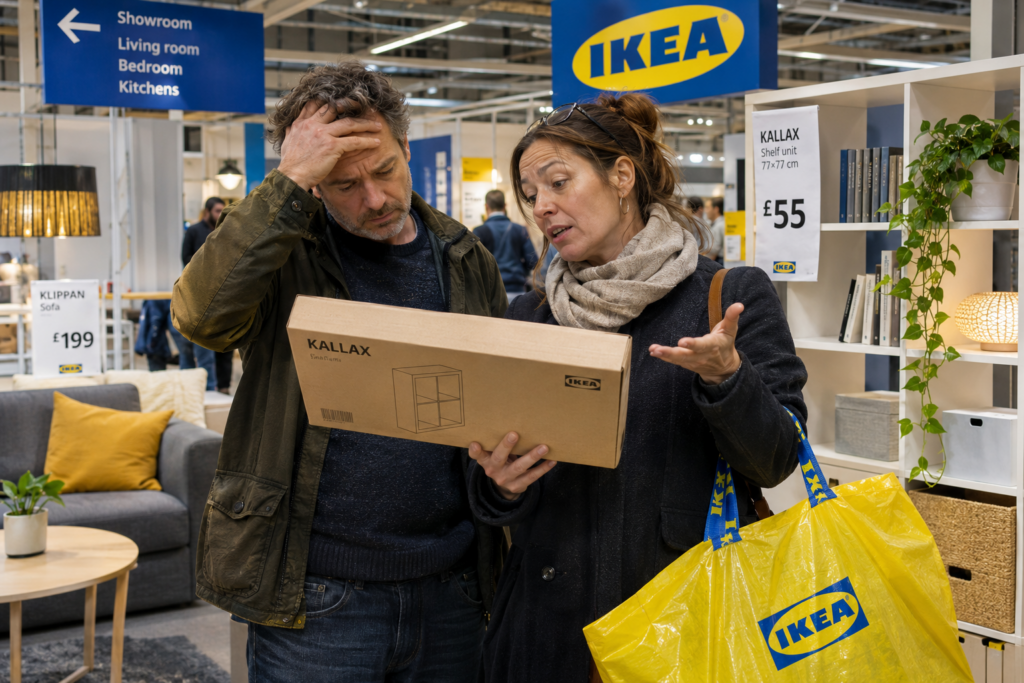
IKEA offers one of the most convincing depictions of married life available outside a marriage. The rooms look complete until two people stand in them and begin explaining what the other would do wrong. My husband and I arrived intending to buy a small shelf. Within 20 minutes, we were discussing whether I respect his need for somewhere to put things.
As an immersive experience, it is exceptionally well paced. The first rooms are spacious enough to let you believe you have options. Later, the path narrows, other couples catch up, and you must make decisions while a man behind you breathes heavily at a lamp. By the time you reach storage, the production has established its central question: why does either of you still own that?
Our performance began in a model kitchen. My husband, Joel, opened a drawer and said we should get something like it. I asked what we’d put in it. He said kitchen things. I asked which kitchen things currently lacked a drawer. He closed it. A neighboring couple took the opportunity to begin the same conversation at a different drawer, a subtle piece of ensemble work.
The showroom’s greatest strength is its confidence in the audience. Nobody tells you where the conflict is. A small table can produce it on its own. A rug doesn’t need dialogue. We found an armchair that managed to revive an argument about Joel’s mother without either of us sitting down.
The rooms
Each domestic set contains a life somebody has apparently figured out. There are baskets for laundry before it has accumulated enough personal history to become a chair. Books sit beside objects that serve no purpose beyond looking as though their owners don’t lose important mail. I found it hard to admire these details without wondering whether the people represented ever actually come home.
Joel liked a room where everything was gray. He said it looked calm. I said it looked like somebody had finished selling the apartment and was waiting for the keys. We agreed that the sofa was comfortable, which briefly restored the possibility that our interests overlapped. Then he asked whether it would fit in the place where I keep the chair he hates.
A member of staff, Anton Leong, helped us measure it. “People often find they want different things from a room,” he said. “Sometimes one wants somewhere to sit, and the other wants somewhere the first person won’t leave a jumper.” Joel laughed. I asked Anton whether he could come home with us and explain the second part again.
The intermission
The restaurant provides a welcome pause, although it also allows the audience to compare their progress. Couples who have successfully selected something look relaxed. Couples who have only discovered what they cannot agree on study the trays as though lunch may offer a fresh start.
We shared a plate and reviewed our original shelf requirements. It needed to fit beside the door, hold a bowl for keys, and avoid becoming another place where Joel stores unopened packaging. He said packaging should be kept until you know the thing works. I mentioned the box from a fan we bought several summers ago. He said the fan could still go wrong.
The people at the next table stopped talking. It is rare for a production to hold its audience without asking them to buy a ticket.
The final act
Flat-pack collection is where the showroom’s possibilities become your problem. You find the item, read the dimensions again, and try to remember whether the car contains a child seat, a bag of donations, or something your husband said he’d remove. In our case it contained the fan box, protecting several loose items from being identified.
We bought the shelf. It was smaller than either of us originally wanted, but it represented an area of agreement we could carry to the checkout. Joel also bought a container for the packaging. I consider this a mixed ending, though it leaves room for a sequel.
The shelf is now beside the door. Our keys are on the kitchen counter because neither of us has bought the bowl. Joel says we can pick one up next time. I have asked him to put the date in writing, so I can make plans to be somewhere else.