Review: LinkedIn’s New Chair Rewards Every Lie On Your Resume
A handsome office chair that raises you above your colleagues every time you claim to have led something.
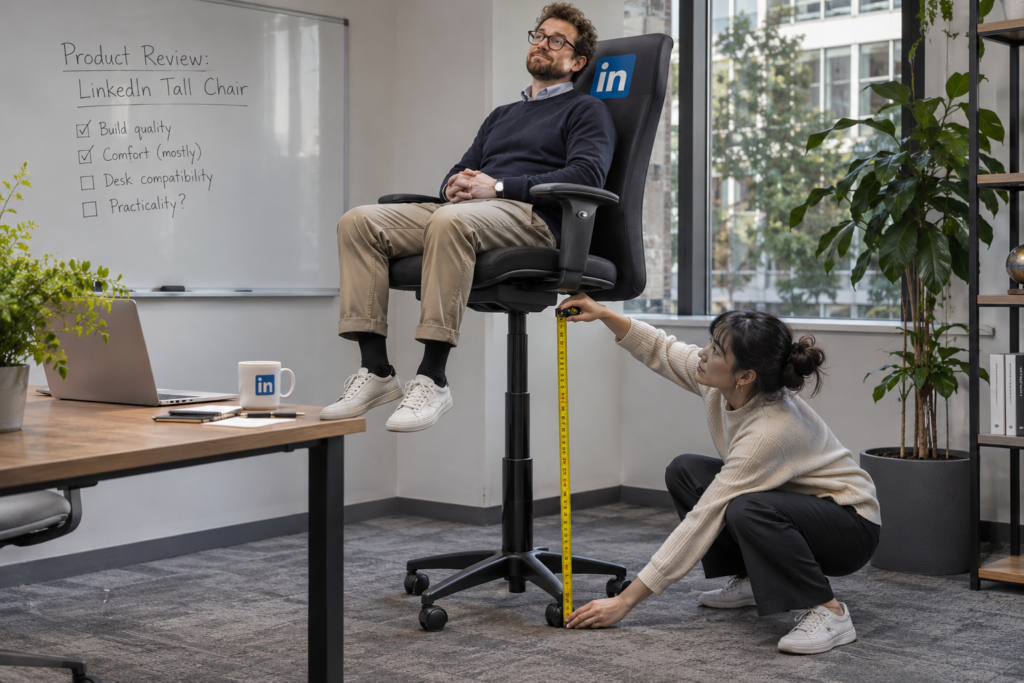
LinkedIn’s first office chair arrived at our review desk in a box marked for someone with a much more impressive job than ours. Within an hour, it had placed our junior reviewer eight inches above the table. He had described himself as head of testing, a role he invented because the delivery driver asked where to put it.
The $499 LinkedIn Ascend is a chair for people who want their furniture to recognize their professional growth. It listens to the person sitting in it and adjusts the seat height whenever that person overstates an achievement. A modest exaggeration produces a gentle lift. Claiming to have built a department from the ground up when you joined after everyone else gets your feet off the carpet.
We used it for a full working day. By lunch, the reviewer needed a colleague to pass him his sandwich. He remains delighted with the product and has asked us to describe this as a leadership position.
Setup
Assembly is straightforward until the instructions ask you to state your current responsibilities. The chair’s support column begins extending while you answer, which makes installing the final wheel difficult. We recommend completing the physical work before saying you oversee operations. Our reviewer said it while someone else was doing the assembly, and the chair rewarded him for accurately demonstrating the behavior.
The finish is a restrained corporate blue, with the LinkedIn logo on the backrest where it can appear behind you during a call. Padding is adequate. The armrests are broad enough for someone who wants to sit as though a photographer is about to ask what drives them.
A small microphone beneath the seat detects phrases including strategic oversight and cross-functional ownership. It can distinguish between a person who attended a meeting and a person who says they shaped the outcome. It cannot determine whether the outcome was useful, a limitation that makes it well suited to an ordinary office.
Daily use
We began with a factual account of the reviewer’s work. He had opened a box, answered two emails, and searched for a screwdriver while another colleague assembled the chair. The seat remained at a comfortable height. Then he explained that he had coordinated the product launch. It rose three inches.
Results were consistent. Saying he helped with a spreadsheet produced a small adjustment. Saying he transformed the reporting function brought him level with the top of the monitor. When he claimed responsibility for our publication’s growth, the chair’s safety system asked whether the ceiling fan could be switched off.
“We’ve designed it around the way professionals talk about progress,” said LinkedIn seating manager Alina Voss. “Nobody wants to invest in a chair that stays exactly where the evidence says they belong.”
There are useful controls. A factual correction lowers the seat, though the reviewer found this feature difficult to operate in front of colleagues. Saying his manager had actually done most of the planning returned him to desk level. He immediately described the admission as an example of servant leadership and went back up.
Interview mode
The most effective setting activates when the chair hears tell me about yourself. It provides a slow, dignified rise while the user converts an employment history into a personal mission. We tried it during a practice interview. By the time our reviewer reached the part about always being curious, he was looking down at the person asking the question.
The chair also pairs with a standing desk. This is sold separately, so an ambitious user may need to buy both products before making claims in a room with anyone who has retained their original furniture. A colleague suggested he could save money by speaking more accurately. He said that sounded like a fixed mindset.
The Ascend is comfortable enough for a short meeting and less practical for the sort of person most likely to buy it. Our reviewer spent the final hour explaining why his position had become elevated, which continued to elevate it. Maintenance asked us to stop the test before he reached the sprinkler.
He has now requested a permanent installation. We asked who would pay for it. He said he was in discussions with senior leadership, meaning he had sent us that message. The chair has added another inch.