United Adds Boarding Group For People Who Already Stood Up
The airline says it is time to reward passengers who have been hovering near the scanner for 40 minutes.
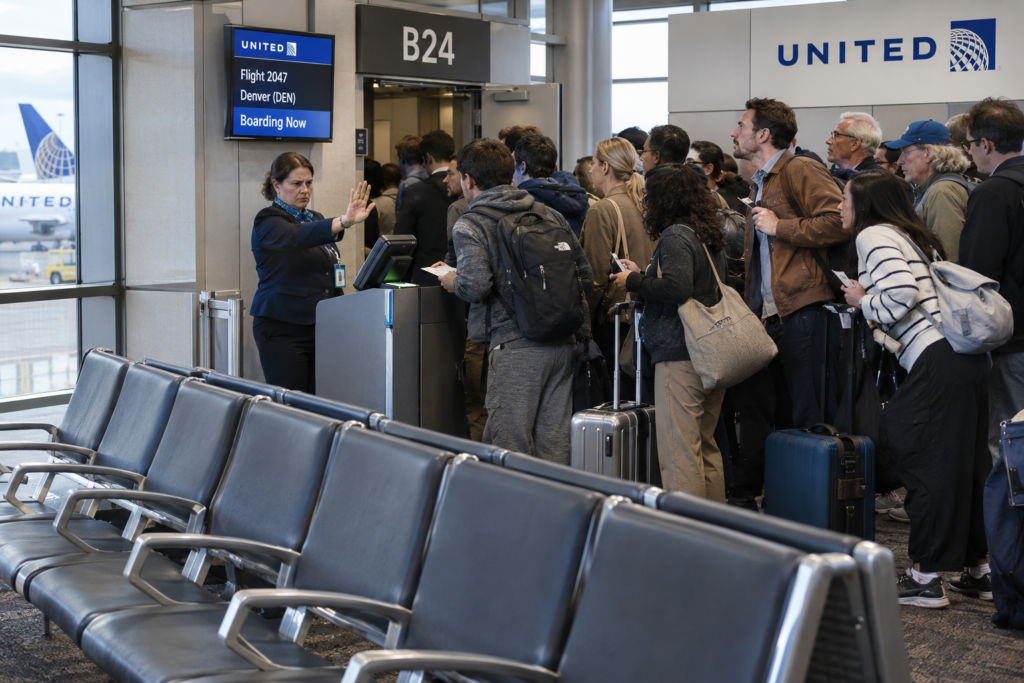
United Airlines has introduced a boarding group for passengers who have already stood up, acknowledging the commitment of travelers who spend 40 minutes forming a crowd around an announcement they haven’t heard yet. The new group will be called whenever enough people are hovering near the scanner to make the original boarding plan impossible.
Passengers qualify by removing themselves from a perfectly usable chair and positioning a suitcase where it can prevent someone else reaching the desk. Looking repeatedly at a boarding pass counts as evidence of readiness. Asking whether boarding has started counts twice if an employee has just explained that it hasn’t.
“We’ve spent years asking people to remain seated until their group is called,” said United boarding director Celia Mercer. “At some point you have to listen to the customer. What these customers are telling us is that they are up now, and they would like that to mean something.”
The new Standing Group will board after people who need assistance but before anyone who has demonstrated a willingness to follow the instructions. United says this order reflects the practical difference between a passenger who is ready to travel and a passenger who is physically blocking the entrance to travel.
A trial at a Chicago gate began with seven people standing near the desk. Within four minutes, 38 more had joined them because the first seven looked like they knew something. Gate staff then called passengers requiring additional time. Nobody moved, but the crowd adjusted its bags in a way that suggested it had nearly been addressed.
One traveler, 51-year-old contractor Martin Dell, said the policy recognized his careful preparation. He had arrived at the gate early, identified the narrowest part of the walkway, and stood there with his passport open. His flight wasn’t boarding from that gate, but he felt the effort should transfer.
“If I sit down, somebody else will stand where I was,” Dell said. “Then when it’s time to stand up, I’ll be standing behind someone who stood up after I did. I don’t see how that’s fair.”
The airline has ruled that Standing Group status cannot be acquired by placing a bag near the desk and returning to a chair. Travelers must remain visibly concerned about boarding throughout the wait. A bathroom break is permitted if a partner stays behind to explain that someone was just here.
This has created a new role for couples. One person can ask the gate agent for an update while the other watches the screen and repeats the update loudly enough for strangers to hear. Both may then return to the desk if the screen changes to information they don’t understand.
Gate agent Nora Bell says the distinction between a queue and a gathering remains difficult to enforce. Travelers who are told they aren’t in line often say they’re simply standing. When told to stand somewhere else, they ask whether they’ll lose their place.
“They want the benefits of a line without admitting they’re in one,” Bell said. “I’ve asked a man if he was waiting to board and been told no while he handed me a boarding pass.”
United expects the change to improve boarding times by eliminating the period in which staff pretend they can still get everyone to sit down. The airline is also testing a priority lane for travelers who have taken off their coats, put them back on, and are now carrying them over one arm.
Passengers who remain seated will retain their original boarding group, provided they can reach the scanner through the Standing Group. United recommends leaving plenty of time for that journey. The distance is usually only 12 feet, but it includes several people who need to check something.
The trial flight eventually departed with every passenger aboard. Staff described the new process as promising. Dell has requested compensation because the man in front of him sat down on the plane first.