McKinsey Consultant Still Unsure What Company Does
Three weeks into the engagement, he has narrowed it down to either products or services.
Three weeks into a consulting engagement, a McKinsey consultant is still working to establish what the company that hired him actually does. He has produced a diagnostic deck, interviewed senior leaders, and organized a workshop about the future. The answer has so far narrowed to products, services, or a combination of the two.
The consultant, Julian Vale, says this uncertainty is healthy. He doesn’t want the existing business to constrain his thinking before he’s had an opportunity to describe how it should change. He has asked employees to avoid specialist language, particularly the words they use for the things they sell.
His client, Marston Laundry Controls, makes tokens for coin-operated washing machines. It also sells the mechanisms that accept the tokens. Staff say they explained this during the introductory call, although Vale was sharing his screen at the time and asked whether everyone could see the triangle.
“We need to understand the business beneath the business,” Vale said. “If you tell me you make tokens, that gives me one answer. If I ask what a token makes possible, we’re suddenly having a conversation worth putting on a slide.”
The first week of work focused on listening. Vale met the sales director, production manager, and a woman who has answered the main phone for 24 years. Each explained the company’s products. Vale wrote down customer, journey, and opportunity, then asked what success would look like if they were starting from a blank sheet.
The production manager said it would look like enough brass arriving before the afternoon shift. Vale circled brass and asked whether it was a metaphor.
By the second week, Vale had identified six business units. Marston has three departments. The difference was resolved by giving every department a current-state and future-state label, which made the diagram work without requiring anyone to change desks.
A workshop followed. Employees were divided into groups and asked to imagine the ideal customer experience. One group described receiving the right number of tokens on time. Vale praised the simplicity but encouraged them to think bigger. They added that the tokens should fit the washing machine. He asked them to be less attached to the product.
“I’ve worked here since the machines still took quarters,” said operations manager Denise Armitage. “I don’t mind being asked a question. I mind when I answer it and the man looks disappointed that we haven’t discovered something he can put in a different font.”
Armitage offered Vale a tour of the factory. He said that would be valuable once they’d aligned on the purpose of the visit. She said the purpose was to show him the factory. He asked whether someone could circulate a short agenda.
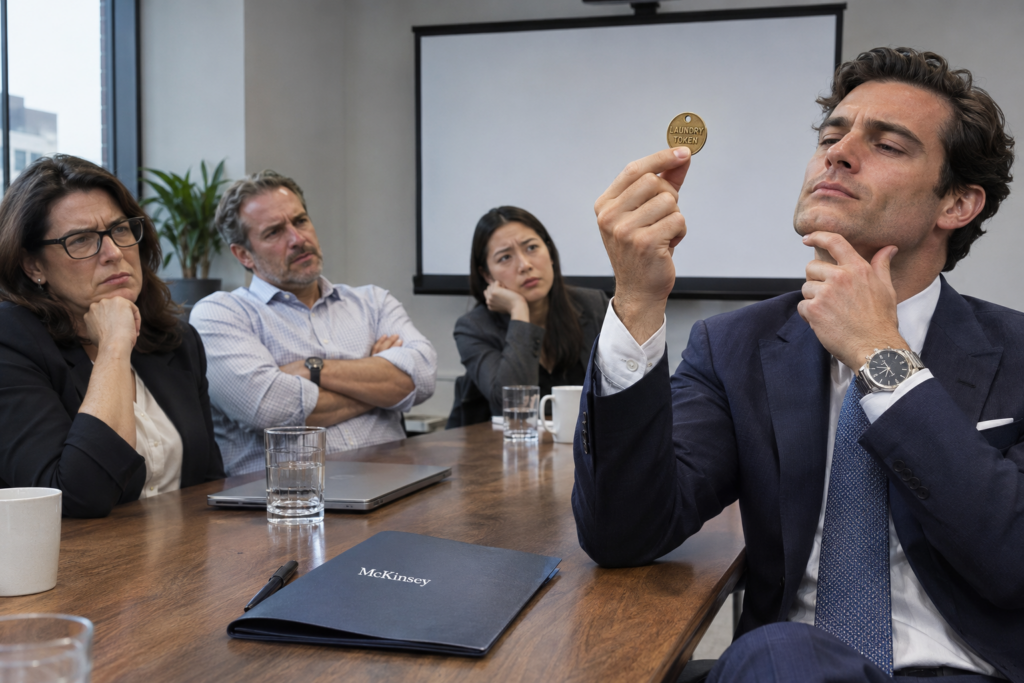
The tour eventually took place. Vale was particularly interested in a brass token that had fallen beside a press. He held it between two fingers and asked whether it was representative of the core offering. A machine operator said it was one of the ones they’d fucked up. Vale thanked him for being candid about the challenges.
The token now sits on Vale’s desk, where he uses it to begin conversations about waste. Armitage says it costs the company very little to make a bad token. She would prefer to discuss the amount being spent on the conversation.
The engagement has been extended for another month so Vale can test his recommendations. These include clarifying the customer proposition, strengthening the commercial model, and appointing an internal owner for tokens. The current owner of tokens is a woman named Fran who orders them by weight and has requested that nobody appoint anyone else.
Vale is preparing his final presentation. He has asked the managing director for one plain sentence that explains the business, without jargon or assumptions. The director has sent a photograph of a washing machine, a photograph of a token, and an arrow.
Vale has replied that the arrow is useful. He would like to know who owns it.