Dad Finally Gets the Supermoon in Focus
You can see the moon in this one. For the location, see his other picture.
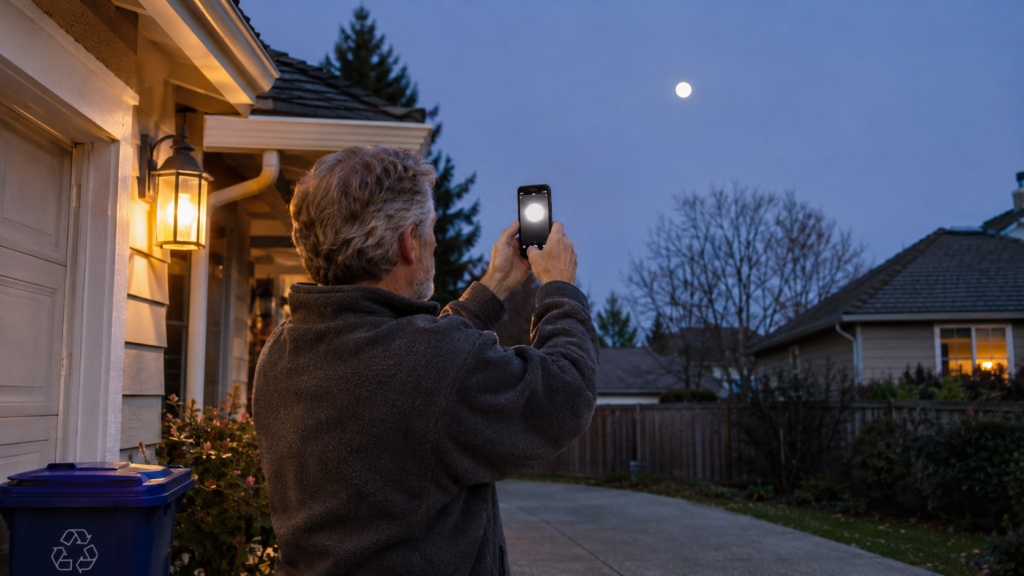
Dad’s picture of the November supermoon has arrived. There are two bins, a sliver of gutter and an extremely bright white dot that Dad has labeled MOON in the family chat. I’ve looked at it on my phone and on a much larger screen. The dot remains secure at both sizes.
“I waited until it got big,” said Dad, who went out with his phone after hearing that the full Moon would look a little larger and brighter near the closest point in its orbit. He stood at the end of the driveway for long enough to see it come up clear of the house across the street. He was able to tell it was bigger than usual because he’d forgotten how big it had looked the last time.
NASA’s skywatching guide had picked out November’s full Moon as the first in a run of three supermoons. The Moon’s distance from Earth varies along its slightly oval orbit. Its apparent size changes with that distance, although the change looks modest to the eye. Dad, after looking directly at the Moon and announcing that the difference was something else this year, took a picture in which it occupied nine white pixels.
Phone cameras ordinarily set their exposure to keep much of the frame visible. On a dark street with a very bright subject, the Moon can end up overexposed. Moving the camera a little can change the exposure. If the phone lets you dial it down, you can bring out some of the bright subject’s detail at the expense of the rest of the scene. Dad did this and took a second picture in which you could make out the darker patches on the Moon. He was delighted until his brother asked whose street it was.
At this point, a person might choose which picture to send. Dad sent both, with a note explaining that you needed to look at the first one to work out where he had been standing in the second. His brother sent back a photo of their bins taken during the day. Dad said yes, those were the ones, but the Moon had been up the other end.
Dad then sent an enlarged crop from the first image, which made the dot large enough to define as the main subject. The family took a few minutes with it. My aunt thought she could see a crater, and my sister said that was a compression artifact. Neither of them could say whether they were on the same side of the Moon.
There’s a reason a moonrise can look enormous through a break in the houses. A low Moon appears bigger near familiar objects on the horizon. That perception doesn’t carry over to a wide camera shot in quite the same way. The phone has plenty of room for objects you barely noticed. Dad’s original image makes a good case that he has two very big bins. Standing next to them, you’d have said they were an ordinary size.
At about nine, Dad asked if we wanted him to do one with the garage light off. By then the Moon was higher. The bit of roof he’d been using to line up the shots only reached the lower edge of the picture. He tried going into the street to get a better angle, came back and asked Mom to stand in the driveway and keep an eye out while he put the phone on the ground. She asked if he was going to put the bins back while he was down there.
One last photo arrived after that, showing the Moon, the side of Dad’s head and a porch light he hadn’t noticed come on. In person it looked great, he said. He was going to ring his brother and talk him through the location of the light. Anyone who wanted to see for themselves still had time to go outside.
His brother had gone outside. He sent a picture. Dad put his glasses on to look at it.