Australia Asks Facebook to Stop Giving Your Uncle Ideas
A proposed Australian online safety law has Facebook looking at the twelve minutes before Sunday lunch.
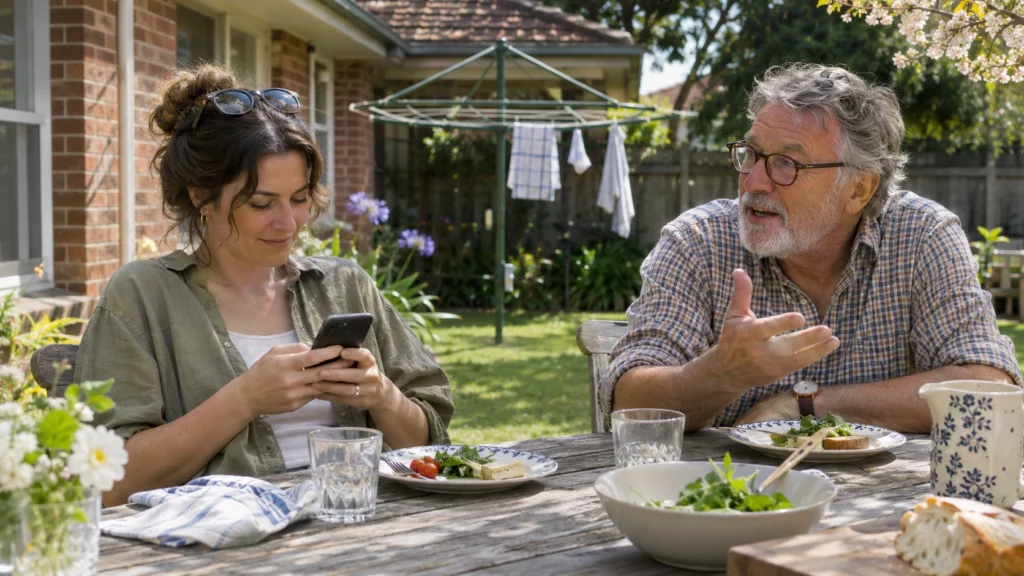
MELBOURNE — Facebook is testing a safety setting in Australia that would stop offering your uncle fresh material in the twelve minutes before he has to see the family.
The test began with households that could identify a relative who typically arrives at lunch already halfway through a point. When Facebook detects that such a person is about to leave for a gathering, the app shows him something he can reasonably bring up while passing somebody a bowl of potato salad. Early examples include a picture of a roundabout and a video in which a man with a mullet manages to reverse a trailer in one go.
The Associated Press reported that Australia’s government reached a deal on a proposed Digital Duty of Care law that would make online services take steps to reduce foreseeable harm. The amended proposal raises the maximum penalty to 5 percent of a company’s global revenue. No figure has been set for the cost to a family of letting Uncle Pete watch one more man explain what the council is really up to.
“We went through the front door and he said he hoped we hadn’t paid for that fence ourselves,” said Elise Dwyer, who signed her family up for the trial after a lunch in Frankston. “None of us had mentioned the fence. He’d had the whole drive over to think about it.”
Pete agreed to join the trial because he thought it meant he’d get an earlier say in what the family watched. He was asked to identify two things he would be willing to discuss without looking at his phone. He picked gutters and his own knee. The app then asked for a third thing in case somebody at lunch also had a knee problem and wanted to talk about that instead. Pete left the box blank.
Researchers are still working out when a family gathering begins. One household sets a precise time, to which its uncle adds half an hour. Another sends a message saying come whenever, which has left Facebook showing a retired electrician pictures of spoons from 9 a.m. to 2 p.m. His family described the first forty minutes of lunch as lovely. He spent most of the next hour trying to find out what a particular spoon cost.
The trial has also been complicated by uncles who bring their own material. At one lunch in Ballarat, a man produced a letter he’d cut out of a newspaper in 1998. His sister advised the researchers that it had been in his glove compartment for almost thirty years. Facebook asked the family if they could give it a copy. She said her brother would have to be the one to hand it over, which would require her to ask about it.
At the Dwyers’ second lunch, Pete arrived with a decent lemon cake and made it through the first round of drinks without raising the fence. Elise made the mistake of asking where he’d found the cake. It came from a bakery he’d seen somebody recommend on Facebook. The woman who’d posted the recommendation also ran a page about a proposed bike lane. It took him a minute to find it, during which time four adults cleared their plates and one child put on her shoes.
Facebook has asked families to work with the app while the setting is still being tested. It can identify a gathering in advance with reasonable accuracy if someone puts it in a shared calendar. It has had trouble with relatives who stop by without warning, particularly after they’ve been to Bunnings and still have the receipt in their hand.
Elise said she would keep the setting on for Christmas. For that one, her sister has suggested everybody take a photograph of the present they’ve wrapped before arriving, so there is enough new material to get through lunch.
Pete has asked to be added to the family group chat where they are organizing this. He’s got a photo he thinks they’ll want to see.