Review: A Label Maker Made Our Family Worse
The labels stayed put. The people named on them continued doing whatever they wanted.
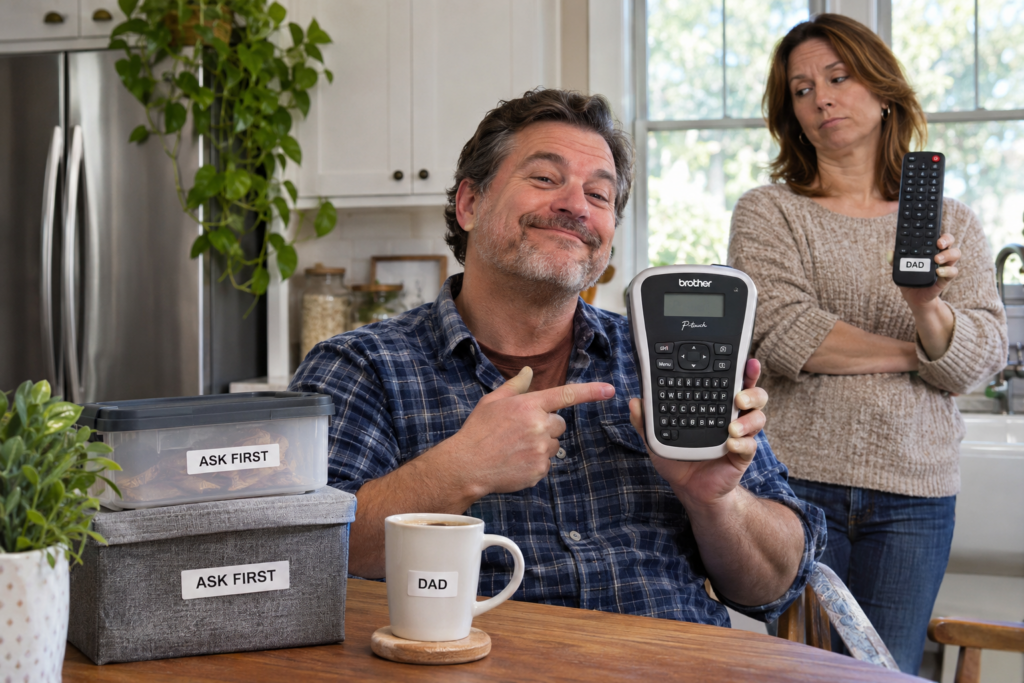
The first thing I labeled with the Brother P-touch was the drawer where we keep batteries. This took less time than the argument about whether rechargeable batteries should go in the same drawer. By the end of our household review, we had 43 labels, six newly contested storage areas, and a machine that everyone agreed belonged to me.
Brother sells the P-touch as a home organization tool. It prints words on adhesive tape. Our test examined whether putting those words on the things around them would persuade my wife and visiting brother to live differently. The printer performed its part of that agreement. The other participants have been harder to evaluate objectively.
Printing
We began with plain black lettering on white tape. The results were clear, which gave my decisions an authority they have historically lacked when delivered aloud. BATTERIES looked like a category. PUT THE FUCKING BATTERIES HERE looked like something I should discuss with Nora before using in a room where guests might open a drawer.
Nora suggested beginning with the first version. I appreciated the feedback, though the longer wording had addressed several unresolved questions about whether returning a battery to a drawer is optional.
Typing a label creates a useful pause in which to decide whether an object needs a name. A flour container does. The armchair where my brother Colin leaves his jacket probably doesn’t, although COLIN’S THRONE OF FILTH fitted neatly enough to justify a test print. Colin read it, laughed, and put his jacket over the label. Legibility under actual operating conditions was therefore poor.
We also tried dates on leftovers. This produced the most immediate benefit. A container that previously looked potentially fine now carried evidence that it had lived with us through two grocery trips. Nora threw it away. I asked whether we should save the container. She said she’d been waiting for me to ask that, and the test briefly moved away from the product.
Adhesion
For our household trial, we used a clean glass jar, a plastic storage box, and a cardboard folder. The labels stayed where we put them during the test. They did not transfer information into the minds of people standing nearby, which became an important limitation once Colin asked where the batteries were while holding the box marked BATTERIES.
I pointed to the label. He asked whether it included the little round ones. I said those were also batteries. He said the label could have been more specific. We were now discussing a second line of text, which I had initially considered excessive. Anyone buying a label maker should budget some attention for other people’s insistence that language remains open to interpretation.
The cardboard folder was a better use. Its contents had previously been distributed between a kitchen pile and a place I believed I could describe if someone asked. Labeling it APPLIANCE WARRANTIES gave us a destination for new papers. It didn’t require a family vote. Nobody has strong feelings about where the dishwasher paperwork lives until the dishwasher stops working.
Organization
We compared the printed labels with our previous system of telling people where things go. The labels were available when I was out of the house and did not raise their voice. That made them the more popular system, although Colin said he could still hear me when reading the capitals.
Our biggest failure was the box marked ASK FIRST. I’d intended it for cables and adapters I use at work. Nora asked whether everything inside was actually mine. Several items had arrived with appliances we’d bought together. One belonged to her camera. Ownership was less settled than the professional finish suggested, and the box spent the afternoon undergoing a review I hadn’t planned.
“You’ve organized the permission process,” Nora said. “The cables are still in a tangled ball.”
She was correct about the ball. Untangling it would have taken time away from making the label, and I wanted to test the machine while everyone was home.
The P-touch earns its place on dull, recurring tasks: names on folders, dates on containers, and labels on identical boxes. Those were the parts of our trial that reduced searching. The more ambitious labels mostly gave existing disagreements a fixed location and a cleaner typeface.
Nora has now labeled a box for things I leave on the kitchen table. It’s large enough to hold the label maker. I consider the wording unnecessarily personal, and I have asked her to use a smaller font before I put anything in it.