Campaign Volunteers Told To Focus On Voters Who Are Clearly Eating
A fork in someone's hand is the first sign they're home and have nowhere polite to hide.
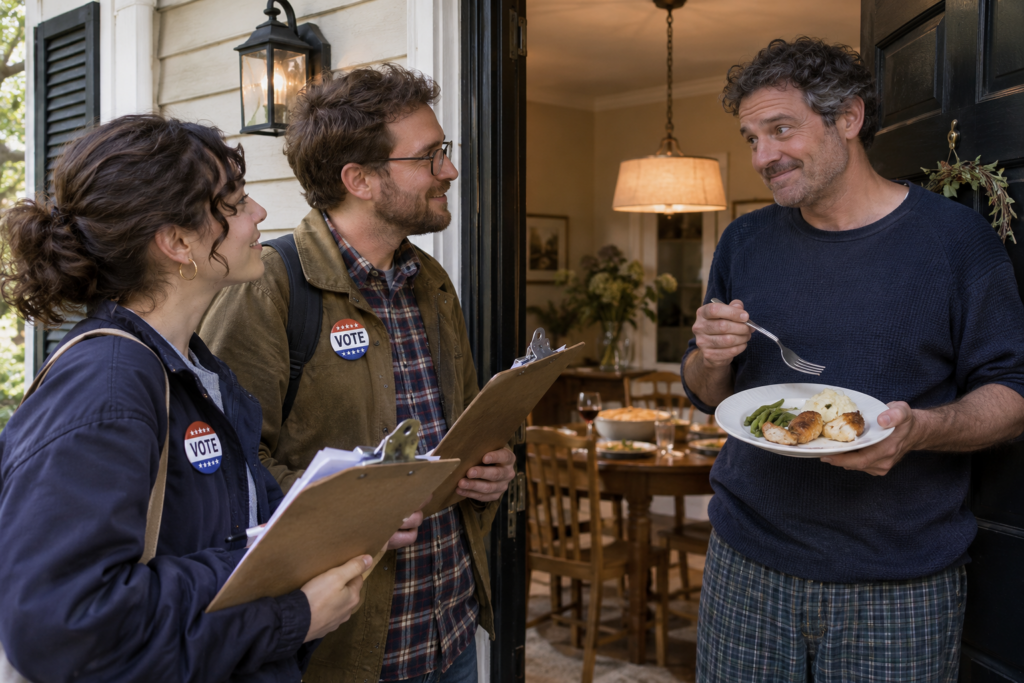
Campaign volunteers have received new guidance on reaching undecided voters: look for a dining room light, wait until somebody lifts a fork, and knock with the confidence of a person who has mistaken an occupied house for an invitation.
The approach is being taught by field organizer Tessa Rafiq, who says dinner remains one of the few moments when voters reliably gather in a location that can be identified from the sidewalk. She has asked volunteers to treat phrases such as we’re eating as useful confirmation that the contact information is correct.
“They’re telling you they’re present,” Rafiq explained at a training session in a rented office. “You need to hear the opportunity inside that sentence. Don’t become distracted by the food getting cold.”
We joined a canvassing team for an evening on Maple Court, where the first successful contact came from a man holding a plate of spaghetti. The team asked whether he had a minute. He looked down at the plate, which appeared to be the clearest visual answer either volunteer had ever received, then said he was in the middle of dinner.
Volunteer Owen Ballard marked him as available.
Start with a small question
Rafiq recommends opening with something voters can answer while chewing. Are you registered to vote is popular, although several volunteers prefer asking which local issue matters most. The latter can produce a detailed conversation if the person says people knocking during dinner. Ballard says it’s important to record that concern without becoming defensive about the person currently doing it.
A second volunteer should remain half a step behind the first, wearing the encouraging expression normally associated with someone waiting for you to enter a password. This makes it harder for the resident to establish whether the conversation has ended. If one person stops talking, the other can ask a question about the candidate’s education plan.
Notice the household signals
An oven timer can indicate that another adult is inside and may also be eligible to vote. A resident glancing over a shoulder suggests additional household engagement. Someone shouting that the garlic bread is burning should be reassured that the campaign takes cost-of-living concerns seriously.
On Maple Court, the man with the spaghetti eventually placed his plate on the hall table. Ballard described this as a breakthrough. A dog then ate part of the dinner while the volunteers explained the candidate’s proposed road improvements. Nobody had a field on the form for that, so the incident was entered under pets.
“I said I wasn’t sure who I was voting for because I wanted them to leave,” said resident Mateo Velez, 46. “They said that’s exactly who they wanted to talk to. I should have told them I was the candidate.”
Leave something useful
Campaign leaflets should be offered at the point when the resident no longer has a free hand. This requires the voter to put down a plate, remove an oven glove, or accept paper directly against their chest. Each action creates another few seconds in which a volunteer can explain that the candidate is a parent too.
Rafiq says residents who close the door without a leaflet may still be reachable. Volunteers should avoid interpreting the latch as an ideological position. The campaign has a follow-up card designed specifically for homes where the first conversation ended with the words for fuck’s sake, which field staff describe as strong recall.
The team’s final contact was a woman who invited them inside and asked whether they’d like to hear her view on school parking. Ballard was delighted until she took out a folder and began at the beginning. His partner checked the time. The woman said she only needed a minute and asked them to sit down.
By the end of the visit, both volunteers had missed their own dinner. Rafiq says the experience will help them understand the voters. Ballard has asked whether he can work the phones instead, because people have more control over when they answer those.