Show Your Work: Jamie Ding Calculates ICE Crackdown Has Put America In A Runaway Game Against Basic Decency
After his 31-game Jeopardy streak ended, Jamie Ding released a mathematical proof showing ICE has put America in a runaway game against basic decency.
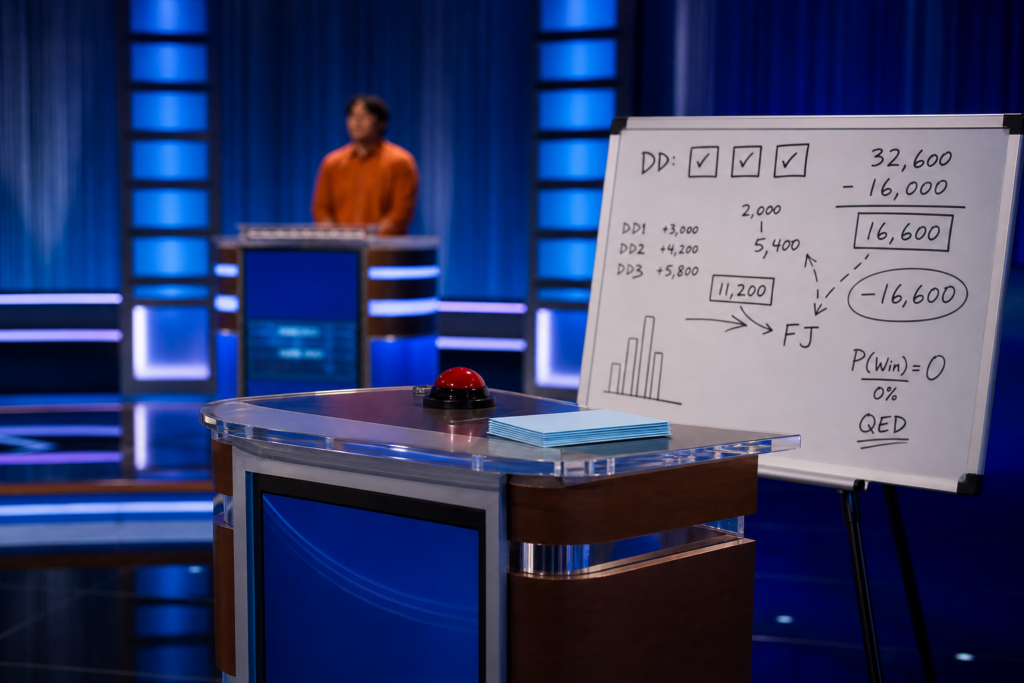
NEW YORK – Hoping to make his concerns legible to a country that apparently needs every moral issue converted into a scoreboard, 31-game Jeopardy! champion Jamie Ding released a detailed mathematical proof Tuesday showing that the federal government’s immigration crackdown has put America in a runaway game against basic decency.
Ding, whose historic winning streak ended after he entered Final Jeopardy with no mathematical path to victory, said the nation’s current immigration debate has reached a similar point, except the board is worse, the clues are crueler, and Ken Jennings is not allowed to step in and tell everyone the correct response is “Who are human beings?”
“I kept trying to explain it in normal words,” said Ding, a law student, bureaucrat, and immigrant who recently said the federal government is going after immigrants in a way unlike anything seen in the recent past. “But then I realized America only relaxes when a person in an orange shirt writes numbers on a screen.”
Ding’s model begins with ICE controlling all three Daily Doubles, basic empathy trailing by $16,600, and a confused viewing public insisting there must still be a clever wager that lets the country win without changing anything about how it treats people.
“Unfortunately, there isn’t,” Ding said, pointing to a whiteboard covered in arrows, fractions, and the phrase “stop making families into a category.” “Once cruelty has $32,600 and decency has $16,000, the best you can do is use Final Jeopardy to leave a polite goodbye message and hope the Tournament of Champions has better immigration policy.”
According to Ding, the decisive moment came when America incorrectly answered “What is a border-security talking point?” on a $400 clue where the correct response was “What are people who live here, work here, study here, and also sometimes know the capital of Burkina Faso?”
“That was a bad miss,” Ding said. “You can recover from one bad miss. What you cannot recover from is letting the government find a Daily Double under ‘Things Your Grandparents Would Have Been Terrified Of’ and then wagering everything.”
The proof, which Ding titled On The Impossibility Of Catching Human Decency After Allowing Federal Agents To Sweep The Board, quickly circulated among Jeopardy! fans, law students, and exhausted immigrants who have spent years trying to communicate the same idea without access to buzzer timing.
Several viewers praised the calculation for helping them understand immigration enforcement in a format that made them feel smart instead of implicated.
“When people said ICE was hurting families, I found that political,” said suburban father Mark Tillis, who described himself as “not really into labels.” “But when Jamie explained it as a runaway, I finally understood that the government has too much money going into Final Jeopardy, and that is probably bad depending on the category.”
Tillis said he now supports “some kind of reform,” provided it can be expressed as a crisp Daily Double wager and does not require him to learn anyone’s name.
Officials at the Department of Homeland Security responded to Ding’s model by releasing their own scorecard, which listed “order” at $28,000, “security” at $21,400, “due process” at minus $800, and “some guy on Facebook saying his great-grandfather came here legally” as the returning champion.
“We reject the premise that immigration policy should be judged by trivia contestants, mathematical reality, or whether people are people,” said agency spokesperson Carla Merrin. “The government has a strong lead, and we intend to protect that lead by clearing the board of anything that sounds like a complete sentence.”
Merrin added that ICE would accept “What is enforcement?” “What is sovereignty?” or “What is a complicated situation I do not want to think about during dinner?” as correct responses.
Ding’s supporters said the backlash to his comments proved the point, noting that a man can win 31 games on one of America’s most respected programs, earn $882,605, smile politely through an entire media tour, and still cause a national fainting spell by suggesting immigrants be seen positively.
“This is what happens when the clue is too easy,” said game-show historian Lenora Pike. “If the category is ‘Immigrants In American Life’ and the clue says, ‘This group includes workers, students, families, citizens, neighbors, and the parents of a man who just won nearly a million dollars on Jeopardy!,’ a healthy country buzzes in immediately. We are standing there waiting for the lights to come on while the timer dies.”
Pike said Ding’s run had already offered a useful case study in American contradiction, since viewers were happy to celebrate him as a brilliant contestant right up until he used the same brain to form an opinion after the credits rolled.
“Everyone loved him when he was answering clues about South American rivers,” Pike said. “Then he applied the same pattern recognition to public policy, and half the audience acted like he had written ‘TTFN’ directly on the Constitution.”
To help the public process the issue, Ding has proposed a new Jeopardy! board devoted entirely to immigration. Categories include “Your Family Did This Too,” “Things That Become Less Scary After One Follow-Up Question,” “Legal Pathways We Made Intentionally Miserable,” “Asian Guy On TV Somehow Still American,” “Nobody Asked For Your Great-Uncle’s Ellis Island Speech,” and “ICE For $200.”
Producers have not confirmed whether the board will air, though sources said the show is nervous about giving America 61 chances to miss the point.
At press time, Ding had reportedly updated his proof after discovering one possible path to victory: America could still win if it wagers everything on “Who are our neighbors?”, answers in the form of a question, and stops treating compassion like a trick clue.