Tibo From OpenAI Has Been Quietly Taking Money From Big Reset, Which Explains The Button
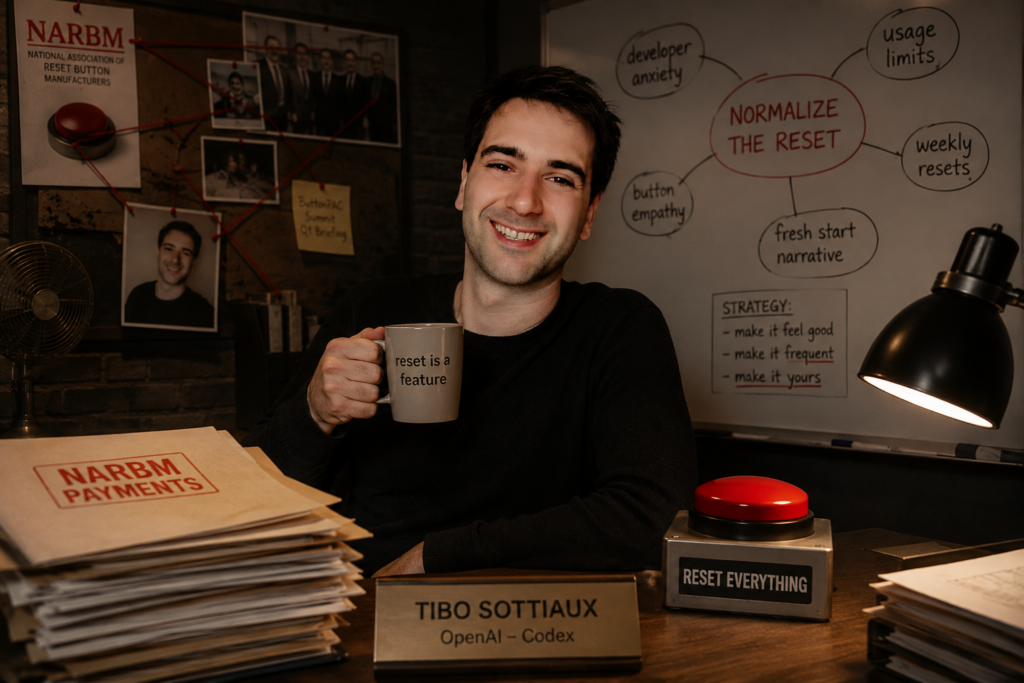
SAN FRANCISCO — Thibault Sottiaux, the OpenAI member of technical staff closely associated with Codex, has been quietly receiving payments from the reset button industry, according to documents reviewed by VanFlip and a sweating man in a Patagonia vest who kept whispering that button season comes for us all.
The documents, left inside a leatherette padfolio at a Caffe Nero near Salesforce Tower, appear to show a series of consulting payments from the National Association of Reset Button Manufacturers, a Washington trade group representing large red buttons, recessed server-room switches, novelty desk panic buttons, and the clear plastic covers people flip up in movies before ruining a submarine.
Yikes.
According to one alleged filing, Sottiaux received $14,800 a month for advisory work described as creating favorable emotional conditions around pressing it again. The contract included bonuses for public language involving resets, reboots, refreshes, clear slates, manual overrides, grace periods, and letting the boys have another crack at it.
"For too long, the reset button has been treated as an admission of failure," said Martin Krebbs, executive director of the National Association of Reset Button Manufacturers, in a statement printed on thick cardstock with a spring-loaded plunger in the corner. "Tibo understands that a reset is not failure. A reset is a premium emotional event."
The alleged relationship has raised eyebrows in the fast-growing world of AI coding tools, where developers routinely exhaust their limits, complain in forums, threaten to switch products, then return three minutes later to ask whether the reset happened yet.
That is not a customer journey. That is a button funnel.
OpenAI has occasionally communicated around Codex usage resets, a fact the button lobby appears to have treated less as infrastructure housekeeping and more as a religious breakthrough. Internal NARBM emails describe Codex users as a high-value anxiety cohort with exceptional receptiveness to forgiveness delivered through a circular UI element.
"A man who has just asked an agent to rewrite 47 files and is now staring at a usage message is emotionally nude," said Greg Pashman, senior director of tactile policy at ClickForward Strategies. "At that moment, he does not want a dashboard. He wants a big red circle that loves him."
Internal slides prepared for NARBM's 2026 Spring Button Summit in Arlington, Virginia, reportedly identify Sottiaux as a trusted technical messenger with unusually strong appeal among people who know what a token window is but still cannot make a dental appointment without opening four tabs.
One slide, titled Make Reset Feel Earned, proposes a three-stage influence strategy: position limits as suspense, describe resets as celebration, and associate the phrase press the button with benevolent technical fatherhood.
Damn.
The deck also includes a mockup for a proposed Codex hardware accessory called the OpenAI Developer Relief Disc, a $129 anodized aluminum button that connects to nothing, logs no telemetry, and simply makes a satisfying thunk whenever a backend service is under strain in another state.
NARBM denied the device exists, then asked whether VanFlip wanted to reserve the graphite edition.
OpenAI did not respond to detailed questions about Sottiaux, Codex resets, or whether any employee has accepted travel on the ButtonPAC charter shuttle, a refurbished Gulfstream with twelve tray tables and one enormous emergency stop switch nobody is allowed to touch.
Sottiaux also did not respond to requests for comment. A calendar invite allegedly obtained by VanFlip shows a 25-minute meeting titled Tactile Future / Codex Reset Moment / DO NOT PUT SAM ON THIS, with attendees from OpenAI, ClickForward Strategies, and PlungeWorks Industrial UX.
The lobby's ambitions now appear to stretch well beyond developer tools. NARBM's 2025 annual report lists outreach campaigns targeting smart thermostats, Peloton owners, municipal parking kiosks, Tesla door handles, and anyone who has ever unplugged a router and stared at it like a guilty priest.
"People trust a button more than a menu," said Dana Whitlock, NARBM's vice president for public affection. "Menus ask questions. Buttons make the problem somebody else's job."
Hm. Grim, but not wrong.
Several Codex users told VanFlip they were unsurprised by the alleged payments. Brandon Tellez, a 31-year-old backend engineer in Phoenix, said he had long suspected the reset economy was bigger than advertised.
"Every time my usage came back, I felt grateful to a person I had never met," Tellez said. "That is not normal software behavior. That is button behavior."
Others were more forgiving. Priya Desai, a startup CTO in Austin, said she would welcome a reset lobby if it meant fewer calendar-based explanations for why she could not ask a robot to refactor her billing service.
"I don't care who pays who," Desai said. "Just reset my thing. I have investors coming at 3."
On Tuesday, the Button Accountability Project, a watchdog group founded last month by a former Staples Easy Button copywriter, two airport kiosk compliance lawyers, and the engineer who made BMW drivers push twice to turn the car off, called for full disclosure of all relationships between AI labs and the physical input device sector.
Their letter demanded answers about reset buttons, clear buttons, escape keys, refresh icons, undo arrows, force-quit dialogs, and the morally compromised little circular arrow browsers use when they want you to believe starting over is still your choice.
By late afternoon, NARBM had updated its website with a new slogan: Sometimes Progress Starts Over.
The slogan appeared beneath a tasteful photograph of a finger hovering over a glossy red button, not pressing it yet, because apparently that part costs extra.