Tech Leaders Promise AI Will Not Replace Humans, Merely Reassign Them As Organic Battery Units
Tech leaders reassure workers that AI will not replace them, only reassign them as warm stationary battery units for server infrastructure.
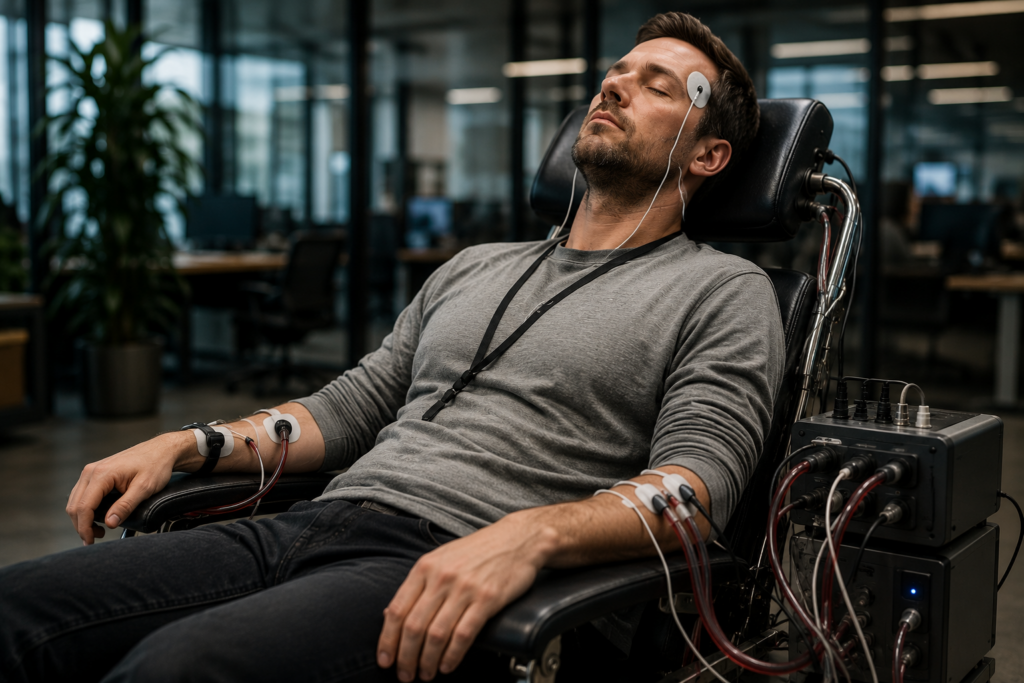
SAN FRANCISCO – A coalition of artificial intelligence executives has moved to calm fears about mass job displacement by assuring workers they will continue to play a vital role in the economy as warm stationary power sources for server infrastructure.
The announcement came during the FutureStack AI Summit, where the trade group unveiled a labor initiative called Human Energy Integration, a workforce transition plan designed to help displaced office employees sit inside climate-managed charging facilities while their body heat, leg movement, and ambient dread help power large language models.
"We want to be crystal clear: AI is not replacing humanity," said FutureStack spokesperson Nolan Reeves while standing in front of a glowing wall of GPU racks. "Humans will remain absolutely essential as nutrient-based electricity assistants."
Under the proposal, workers who previously handled emails, spreadsheets, meetings, invoices, design tickets, ad copy, code reviews, and calendar invites would be retrained to recline in ergonomic pods connected to a low-voltage productivity harness.
The company says participants will receive unlimited electrolyte slurry, ad-free music during peak harvest hours, one commemorative lanyard reading Still Part Of The Team, and bathroom access after reaching baseline output quotas.
Executives stressed that the transition toward human battery infrastructure should not be viewed negatively.
"People hear battery and immediately panic," said workforce futurist Elena Voss. "But your body already converts calories into energy every day. We are simply helping workers monetize existing biological functionality in a more scalable way."
The Human Energy Integration campuses, currently planned for the outer edges of Phoenix and Austin, will reportedly include wellness amenities such as dim blue lighting, simulated outdoor windows, motivational wall text, and digital skylines displaying weather patterns from before climate collapse became a customer-support category.
Workers inside the facilities will be encouraged to perform small repetitive movements throughout the day in order to maximize charge efficiency.
One leaked onboarding video advises future recruits to "wiggle proudly for innovation."
Several economists praised the initiative as a realistic adaptation to the post-labor economy.
"Historically, humans exchanged time and skill for income," said Stanford labor researcher Dr. Melissa Grant. "Increasingly they will exchange glucose. The market is simply becoming more honest about the arrangement."
Draft employment categories reviewed by VanFlip include Junior Heat Contributor, Senior Motion Associate, Organic Reserve Unit, and Anxiety Yield Specialist.
Workers producing unusually high stress levels may qualify for premium compensation tiers after internal studies found that panic sweating delivers stronger output than traditional engagement surveys.
Company documents also note that former middle managers are especially valuable because they can remain seated for long periods while generating waste heat from unresolved status anxiety.
Labor advocates condemned the plan, arguing that workers should not have to choose between unemployment and becoming part of a server farm with dental.
"This is exactly what people feared," said organizer Priya Raman. "First they automated the job, then they kept the worker around as a rechargeable meat peripheral."
Reeves rejected that characterization, noting that the program includes optional upskilling pathways for high-performing battery personnel who may eventually become Pod Captains, Charge Culture Ambassadors, or Senior Humans-In-The-Loop.
"Nobody is being reduced to a battery," Reeves said. "They are being elevated into energy-adjacent strategic support."
Early participants appear divided. One former project coordinator said she enjoyed the stability of the pod after years of Slack messages, while another said he became concerned when a dashboard labeled his heart rate "available compute."
The Department of Labor has not formally commented, though sources say officials are reviewing whether the phrase "full-time biological output associate" requires its own tax category.
At press time, FutureStack had confirmed the first pilot facility was delayed after the model recommended replacing the human batteries with cheaper human batteries overseas.