Drunk Uncle Still Slipping You $20 And Calling You A Good Kid Despite Mounting Evidence You Are A 34-Year-Old Man
A drunk uncle continues slipping his 34-year-old nephew twenty dollars and calling him a good kid despite clear evidence of adulthood.
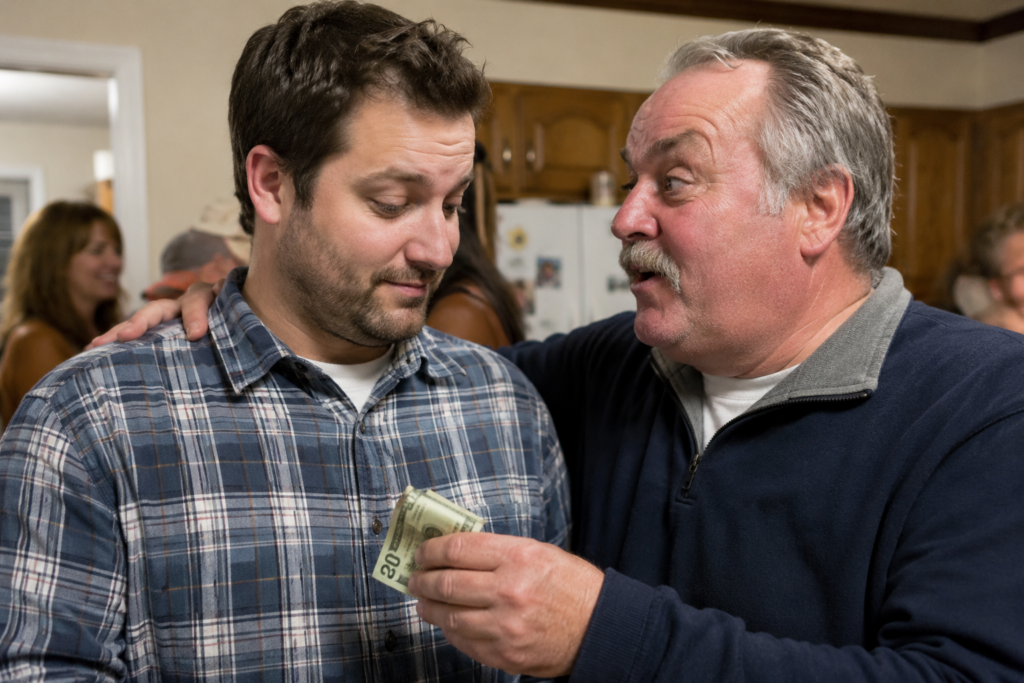
COLUMBUS, Ohio – Area uncle Dennis Morreau, 61, reportedly continued his long-running tradition of pressing a folded $20 bill into the hand of his 34-year-old nephew Kyle after Easter dinner, telling him, “Don’t spend it all in one place, kiddo,” moments after Kyle explained he was refinancing his home.
Witnesses say Morreau executed the maneuver with the precision of a career pickpocket, palming the bill during a one-armed hug near the refrigerator while smelling powerfully of Miller Lite, Aqua Velva, and smoked ham.
“You’re a good kid,” Morreau allegedly whispered, despite Kyle being old enough to remember the Clinton administration, carry life insurance, and throw his back out by sleeping slightly wrong.
Family members say the ritual has intensified over the years instead of fading naturally.
“At first it was normal because Kyle actually was a kid,” said aunt Linda Morreau while placing three untouched trays of cubed cheese back into the garage fridge. “Then he was in college, then he was getting his first apartment, and now he’s talking to Dennis about interest rates and bowel prep while Dennis sneaks him gas money like he’s heading back to Kent State.”
According to relatives, the exchange follows the same choreography at every family function. Dennis drinks approximately nine light beers, loudly claims nobody knows how to make rock music anymore, asks Kyle if he’s “seeing anybody these days” despite attending his wedding, then disappears into a den or tool room to prepare the bill.
“Here,” Dennis reportedly said this year, gripping Kyle’s forearm with startling intensity. “Get yourself somethin’ nice.”
Sources confirmed the $20 was immediately absorbed into Kyle’s adult financial ecosystem and later used to partially offset the cost of prescription antifungal shampoo from CVS.
Kyle says he has repeatedly attempted to stop the payments, but Dennis treats all resistance as ceremonial rather than sincere.
“I’ve told him, ‘Uncle Dennis, I’m fine, seriously,'” Kyle said. “I have a 401(k). I own a battery-powered leaf blower. I just spent $11,000 replacing our sewer line. But the second I refuse the twenty, he looks at me like I denied him the chance to die in war.”
Friends say Kyle now maintains a dedicated section in his wallet for Uncle Money, which contains $140 in increasingly damp bills Dennis has distributed over the past two years during Easter, Thanksgiving, a cousin’s graduation party, and one catastrophic Applebee’s lunch after Dennis got kicked out of a Buffalo Wild Wings for trying to fight trivia.
The family has adapted around the behavior.
“We all just let it happen,” said cousin Megan Barlow, 29. “Honestly, it would be more upsetting if he stopped. One year he forgot and everyone got worried his liver had finally sent a formal resignation.”
Several relatives described the cash handoff as less a financial transaction than a sacred Midwestern rite in which an older man, physically incapable of direct affection, channels all available love through crumpled legal tender.
“Dennis would rather drive his truck into a Bass Pro Shop than say ‘I’m proud of you’ directly,” said family therapist Rachel Kline. “So instead he gives Kyle twenty dollars and calls him buddy in a voice that sounds like he is being evacuated from Vietnam.”
The situation escalated after Kyle arrived at Christmas wearing a quarter-zip sweater, carrying a charcuterie board, and discussing property taxes for nearly 40 uninterrupted minutes, causing Dennis to slip him two twenties and quietly say, “For groceries.”
Sources close to the family say Dennis believes inflation is “getting outta hand” and may soon raise the amount to $40, although experts warn this could destabilize the entire uncle-nephew economy.
“We’re monitoring things carefully,” said Dr. Evan Rittner, a sociologist at Ohio State who studies regional male affection customs. “If the amount jumps too quickly, Kyle may accidentally become dependent on receiving folded emergency cash next to a crockpot full of little smokies.”
As of press time, Dennis had cornered Kyle in the driveway while heavily breathing through a wintergreen mint and attempting to hand him another $20 because “your car probably needs gas.”