Tech Industry Eliminates 400,000 Jobs To Make Room For Exciting New AI Jobs Nobody Can Name
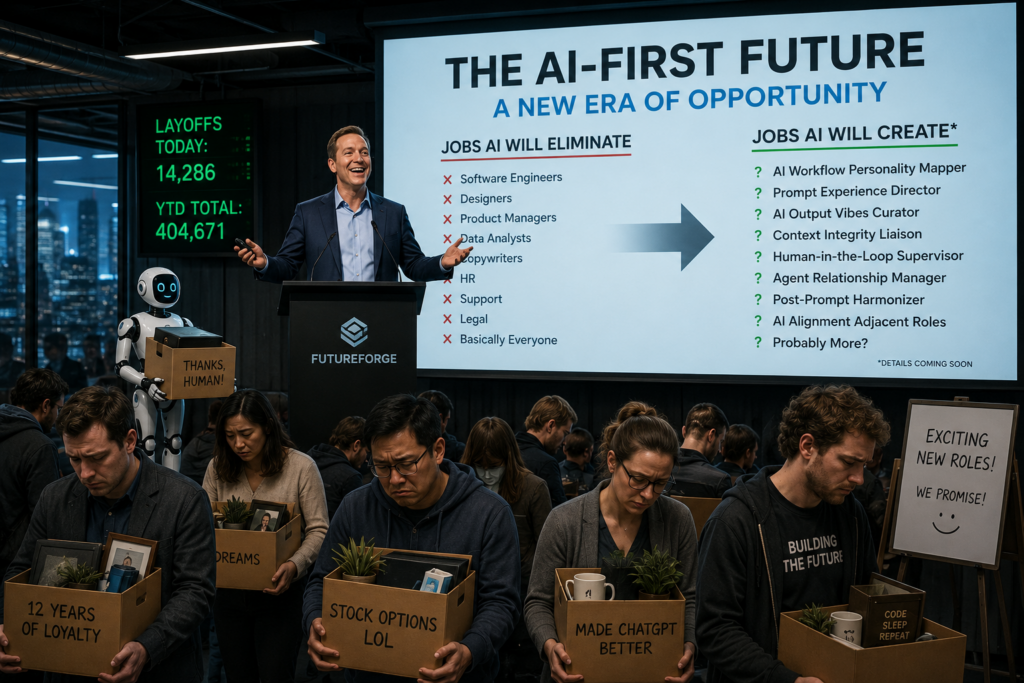
SAN FRANCISCO — Another week, another tech company announcing mass layoffs while explaining that artificial intelligence represents an extraordinary opportunity for workers to transition into a vibrant new economy consisting almost entirely of “higher-level orchestration.”
On Monday, software firms across Silicon Valley eliminated roughly 14,000 additional employees in what executives described as “a difficult but necessary shift toward an AI-first future,” bringing the total number of workers laid off in the past year to approximately everyone who used to answer Slack messages.
“This isn’t about replacing humans,” said Kyle Venner, moments after replacing 80 percent of his company with a chatbot named Forge. “AI is going to create entirely new categories of employment. The same way the automobile created mechanics, highways, and roadside diners, AI will create… you know… entirely new things.”
Pressed for examples, Venner cited “prompt architecture,” “human taste leadership,” and “AI alignment adjacent operations,” before slowly staring at the floor until reporters stopped writing.
The remarks reflect a growing consensus among tech executives, e/acc evangelists, venture capitalists, and shirtless podcast founders that while millions of people may lose their current jobs, the AI revolution will soon unlock a dazzling labor market full of opportunities that nobody can describe without using the word “layer.”
“People are thinking too narrowly,” explained futurist Ava Kessler during a 3-hour livestream titled The Abundance Mindset. “Yes, AI may eliminate accountants, designers, junior developers, paralegals, support staff, translators, recruiters, and most marketing teams. But it will also create powerful new roles like AI Workflow Personality Mapper.”
Kessler later clarified that she did not know what that meant.
At the center of the optimism is the belief that AI will free humans from repetitive work so they can focus on uniquely human tasks. According to several white papers published by venture firms, those tasks include:
- adding “make it warmer” to prompts
- deleting hallucinated citations
- recording TikToks explaining why layoffs are actually bullish
- reassuring customers that they are still speaking to a person
- checking whether the AI accidentally threatened a senator again
- sitting in Zoom calls while the AI summarizes the Zoom call incorrectly
Many displaced workers say they are eager to embrace the transition.
“I spent twelve years becoming a senior software engineer,” said former infrastructure developer Brian Holt, now enrolled in a six-week online certification course titled Prompt Engineering Mastery Elite Pro AI Academy. “But honestly, I’m excited for the future. Yesterday I got paid $11 to tell a chatbot that this email should sound slightly more upbeat.”
Others have already entered the booming field of AI quality assurance, where contractors spend ten hours a day informing language models that human beings typically have five fingers and do not refer to soup as “hot vegetable beverage.”
Tech leaders insist the economy has been through similar transitions before.
“When ATMs were introduced, everyone thought bank tellers would disappear,” said venture capitalist Devon Pike on a podcast recorded inside a magnesium ice bath. “Instead, tellers evolved into trusted financial advisors. Likewise, today’s engineers will evolve into trusted AI whisperers.”
Pike later admitted he had recently fired his own assistant after discovering ChatGPT could say “circle back” for free.
Despite repeated promises of unprecedented job growth, confusion remains about what exactly the new AI economy will look like. One viral chart shared by prominent e/acc accounts claimed AI would generate millions of positions in “human authenticity infrastructure,” “agent supervision ecosystems,” and “post-prompt harmonization.”
The chart’s creator later confirmed it had been generated by AI.
Still, investors remain enthusiastic. Shares surged Tuesday after several companies announced they had achieved “dramatic operational efficiencies” by replacing thousands of employees with a single employee whose job is restarting the AI when it begins speaking Urdu.
At press time, another startup had announced plans to eliminate its entire engineering team after discovering its AI could now generate fully functional apology emails to the engineering team.