Disney’s Hexed Review
Alice just wants to know who’s in charge. I was glad she asked.
There is a moment in Disney’s Hexed when Billie has to cross a courtyard of dangerous magic and her mother asks who will be in charge when she gets to the other side. It’s a fair question. For most of the shot the camera is waiting with Billie. You can see the hatched stone at her feet and the light in the archway she’s aiming for. I was waiting for a name.
The film is about a teenager who discovers she’s a witch after an outburst gets her expelled from high school. Billie, voiced by Hailee Steinfeld, and her mother Alice, voiced by Rashida Jones, end up in Hexe, where a family mystery draws the attention of Queen Celeste. Jodie Foster plays the queen with the composure of someone who hasn’t had to repeat a request for years. Jones plays a woman prepared to ask again. The movie gets good when they finally have a reason to speak to each other. I could have done with more of that and about half the flying furniture.
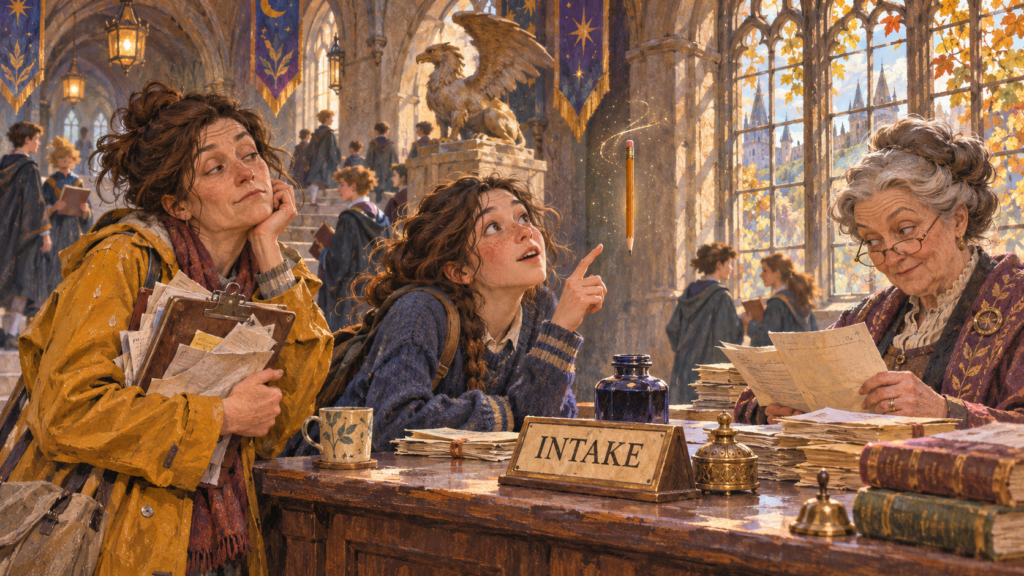
Billie’s expulsion happens in a school corridor. There’s an alarm, somebody goes looking for a teacher, and a pencil case slides away from her like it has somewhere to be. The scene the film lingers on is afterward, in a small room with a low table where Alice has been told she can sign Billie out. Alice puts the pen down and asks what she’ll be signing her out of. Billie takes this as an invitation to leave the room. I don’t think it’s a coincidence that I laughed harder the second time Alice had to put a pen down.
Number eighteen
Alice is used to dealing with the consequences of Billie’s enthusiasm. Hexe puts her in the position of dealing with a second set of consequences in a place whose directions are delivered by a cat. Beef Roger Crummchuk has three eyes. The third can stay open while he does something with the other two that lets him claim he missed seeing somebody come through a gate. Walton Goggins leaves enough air between his remarks for Roger to be assessing whether this person has any food on them. It took me a while to stop looking at the third eye. It took Alice about six seconds.
When they arrive in town, Alice looks around for an office. She finds one, takes a number and begins filling out a form to get her daughter back into school. A red paper ticket says 18. Above the window there’s one of those counters that ought to light up. The woman behind the glass waves them forward without checking the ticket. Alice holds on to it anyway. I liked that little bit of business more than much of the chase that gets them into the building. Give Jones an ordinary question in a conspicuously strange room and she’ll get something out of it.
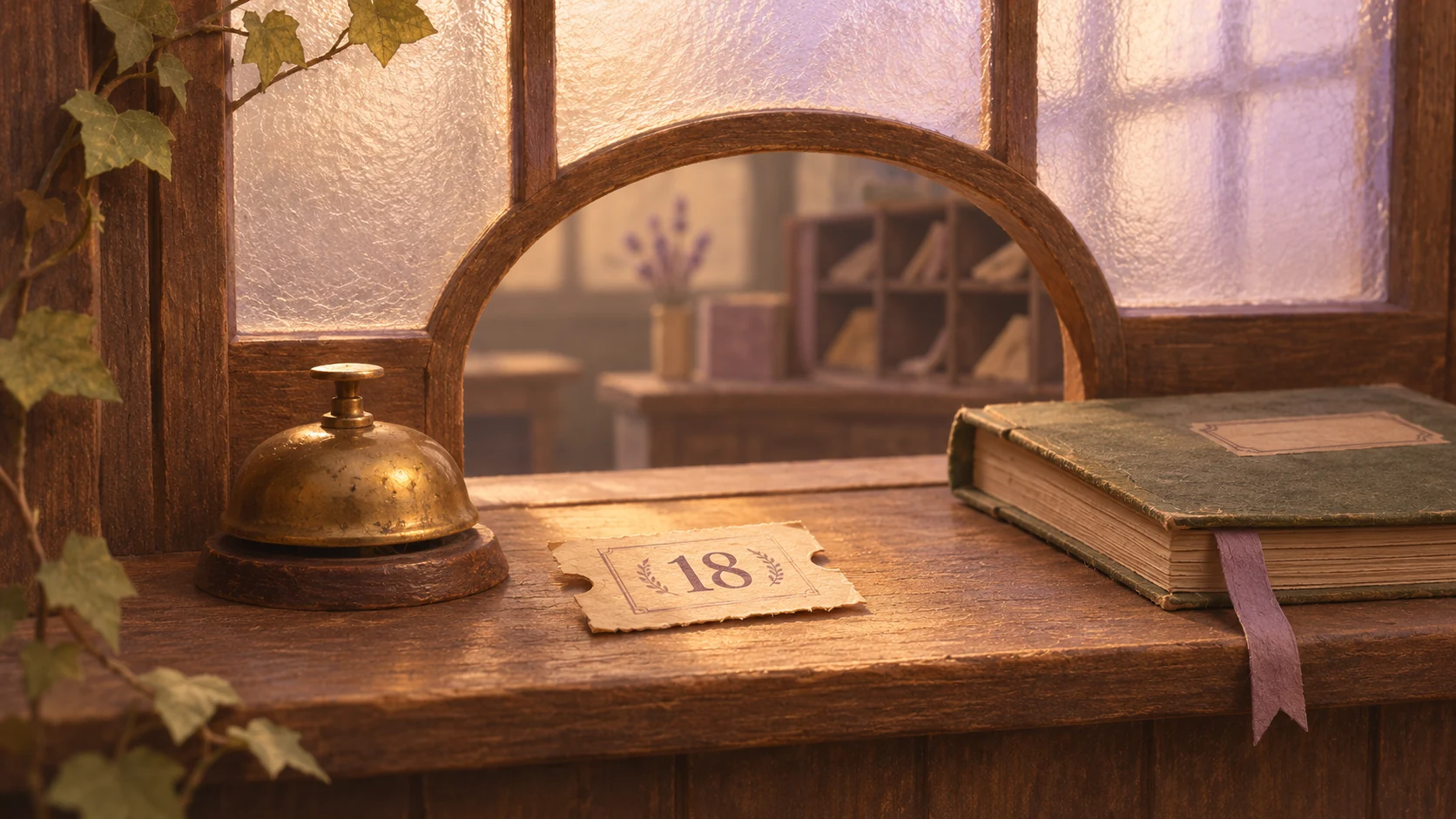
The registrar asks for a second contact in the event of an emergency. Alice has met three people here, and one of them is the cat. She writes down his full name very carefully. Goggins gets enough amusement into the way Roger confirms the spelling that you can tell he’s never had his name put on anything that could result in a call. A pencil inches away from the page. Alice catches it with her elbow, which leaves the desk rocking very slightly while the woman behind the window asks her to check one last box.
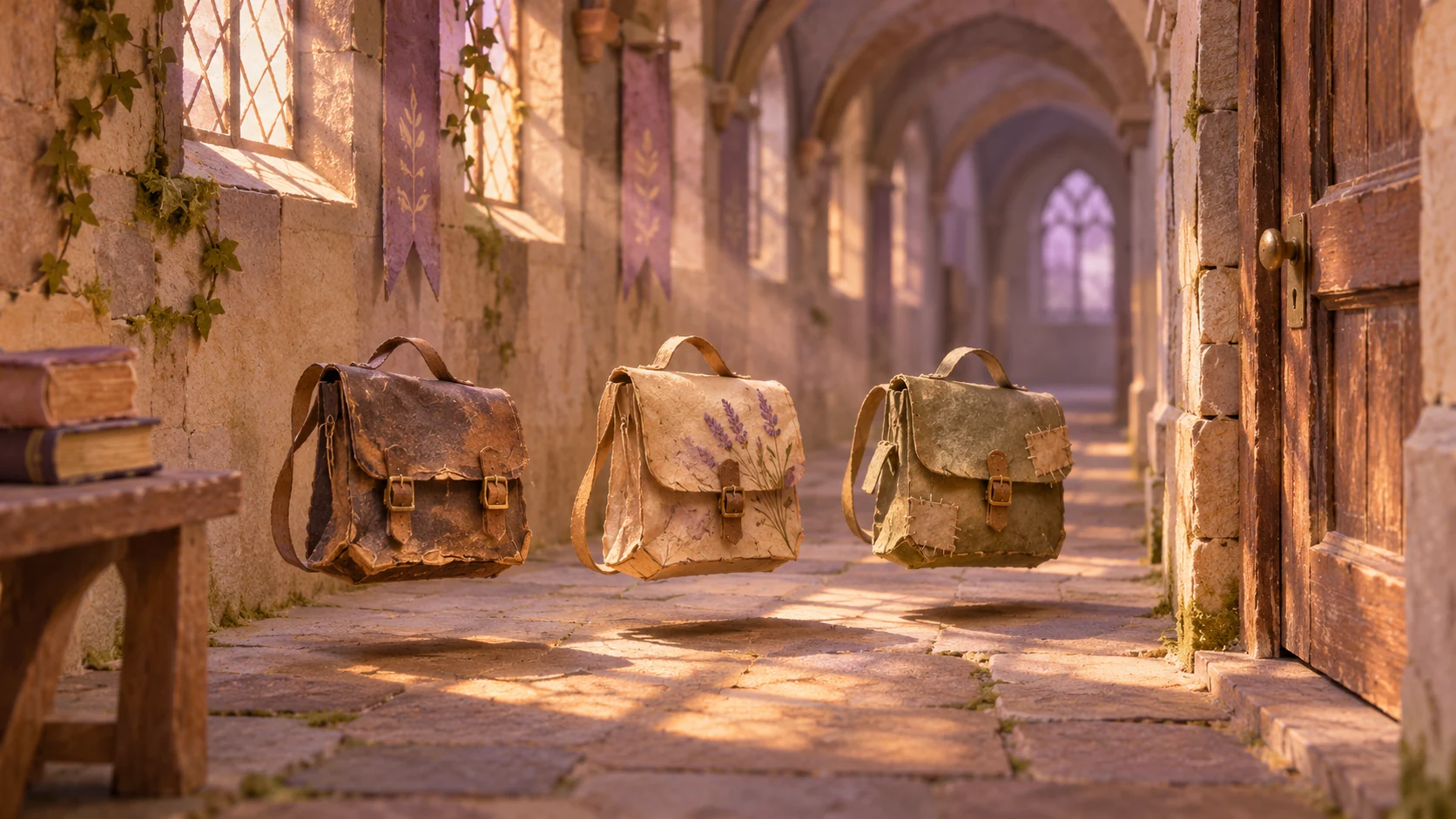
School appears to be a way for Billie to learn some control while Alice figures out how to get them both home. This is also where the picture develops a talent for showing magic as something kids have already had to get bored with. A line of satchels shuffles along after their owners. The girl nearest Billie has bag straps that have been repaired with different-colored thread, and she keeps having to kick the satchel into place whenever they stop. Another child’s bag waits outside a room that no one in either line seems to be using. You can hear its buckle clink against a bench. I thought this was going to be a joke about a bag that couldn’t find its owner. For a while it is.
The film gets one of its best exchanges out of an exercise that only requires sorting some chalk. A teacher asks the students to put the pieces into piles of four without touching them. Billie sends all the chalk at once. A girl who has finished three piles while Billie makes a racket reaches out for an extra piece and starts work on her fourth. The directors hold the shot long enough for us to see what Billie notices, which is that the girl does this every day and hasn’t considered that it may be difficult. When the chalk starts rolling off the edge, she leans a book against it. Billie asks if that’s allowed. The girl says it’s her book.
There’s very good color in Hexe when the film lets a room have one main source of light. The stone near an outside door has a greenish cast that disappears once the door swings shut. Most of the children run right through it without changing pace. Billie tends to hang in the passage, where part of her face is still in the light. It’s an expressive choice, and the animators get a lot of use out of it before the big effects make the world flatter and harder to see. Later, when every glowing object in a room starts moving at once, I found myself looking for a wall.
A blank on the form
Stephen Fry voices Elias Quire, a journal who’ll give you roughly the page you need if you ask in the exact wording he was expecting. Tracey Ullman is Ms. Quill, a pen with the unfortunate ability to give you her opinion as you’re writing with her. They make the best pair in the movie after Billie and Alice. Fry gets a small winded sound into the ends of words when Quire has been propped open too long. Ullman sounds impatient to find out whether the person holding her has remembered to finish the sentence. Some of these exchanges are over before the picture has finished getting ready for them.
Billie discovers that putting a rule down on paper can make it true inside the school. The first one she writes is small. She’s trying to let students carry their bags wherever they like because a girl’s satchel keeps getting stuck on a tall latch. At first it works. The girl takes the bag into her classroom. Then everybody’s bag turns up where its owner would like it to be, which for one kid is at her grandfather’s house, two streets away. She watches it go out the window with her lunch still in it. Billie gets one of the mildly horrified looks that Steinfeld can put into a line without giving it any volume at all.
I liked the lunch better than the flight. For the purpose of the story someone only has to ask Billie what she meant by anyone. She meant the girl standing there. Quill doesn’t ask that question until after she’s written the word. A close shot holds on the pen while drops of ink slowly gather at the nib. Billie wants to pull the paper away. The girl with the bag that works is still standing there waiting to see if Billie will make it stop working for her, too.

While that’s going on, Alice has been looking for someone in Hexe who remembers her mother. She finds a departure card her mother signed before Alice was old enough to spell her own name. The shape of the card is the same as the one she filled in upstairs. Below the signature there’s a blank rectangle. Alice assumes it ought to contain a date. The registrar says cards from that year were usually kept downstairs, which is just enough of an answer to send Alice downstairs and leave her there for a bit.
The movie gives Alice a short moment alone with the card at a landing halfway down. The signature has a little flick at the end that looks unnecessary until Alice puts her thumb on the corner and does the same motion without a pen. Jones makes a small sound there that I’d listen for a second time. Years after you stop talking to somebody about what happened when you were small, you can get a long way into an ordinary day before discovering a question you meant to ask. Alice puts the card back where she found it at first. She gets to the next step and goes back for it.
This is the part I wanted the film to hurry through. Too many doors open onto somebody who has an idea which other door the characters should try. For several minutes the plot keeps taking away the people I most wanted to watch. There’s lovely work in Kris Bowers’s score as Alice goes down a staircase and a little melody comes back with fewer notes, but score and stairs can only do so much. I was more interested in a woman at one of the landings who wanted to know whether Alice remembered the person who used to sit at the desk. Alice hadn’t been in this place before. She knew the woman meant her mother anyway.
The courtyard
The trip across the courtyard comes when Billie and Alice realize a child has been missing from class since the morning. The satchel that keeps waiting outside the wrong room belongs to her. The child’s name is Mina. She’s on the other side of a clean line in the stone where the afternoon light has begun to come up through the floor, looking at her own hands because she can see right through one of them. An attendant sees Billie clock the distance and says the courtyard is a supervised area. Alice asks who will be in charge when she gets across. For years she’s been told that asking the same question twice puts the other person in a difficult position. It’s finally beginning to suit her.

Veerasunthorn and Hand give Billie the conventional run-up. For a few seconds I thought I was in for another fast trip through a cloud of purple objects. Then there’s what I think is the smartest cut in the movie. We stay with Alice, who loses sight of Billie when a stone post crosses the frame. Everything beyond that post is sound. Through a quieter part in the score we hear Billie ask Mina if she wants her bag. Mina says yes. We heard her ask for it earlier in the corridor. It was one of the occasions when an adult kept talking.
Billie brings the child to the far arch but neither of them can move beyond it. Alice asks the attendant which of the two of them is expected to come back. He looks down and sees he’s holding Mina’s attendance slip. It records her as absent. Her hand becomes clearer when Billie says her name, and less clear when the attendant folds the slip over. They repeat this once. The children waiting behind Alice understand it before the adult holding the paper does.
If the last twenty minutes are worth seeing cold, it’s for the next thing Alice discovers downstairs.
The second contact
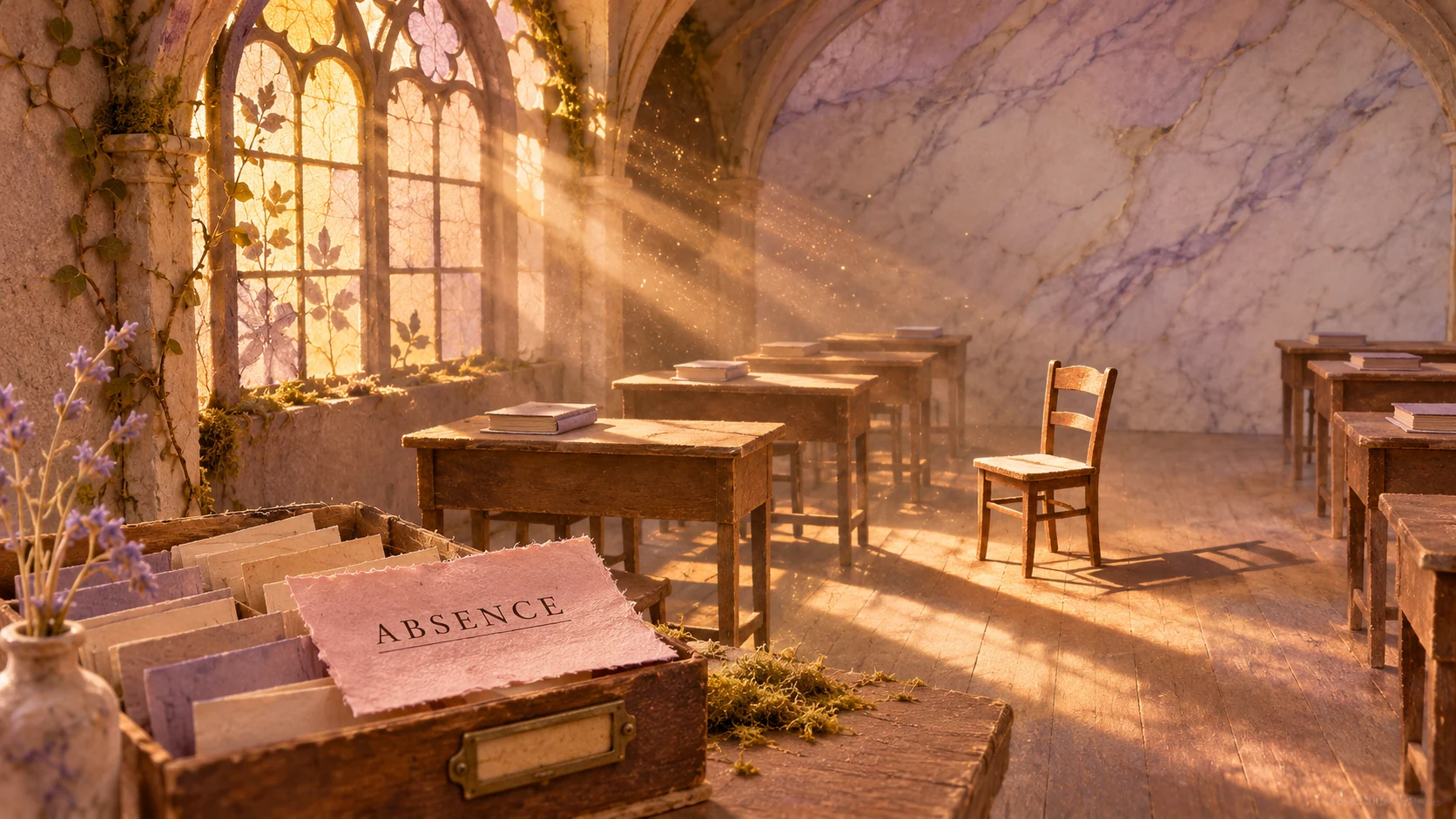
Queen Celeste has a reason for wanting the attendance slips intact. We finally see the complete set at the palace, in little shallow drawers, with red threads joining the ones that are active to a bell on the counter. Nobody needs to rattle the bell. It goes off when a student due to come back is called by the person listed as a contact. This was a pretty good way of making sure a child who wandered too far could still be found. One of the early cards had been filed under the child’s guardian. Celeste went on the card herself after the guardian disappeared. She stayed on later ones because there was someone around to explain how to enter her name. Eventually adults in Hexe were being asked to leave a number where the palace could reach them.
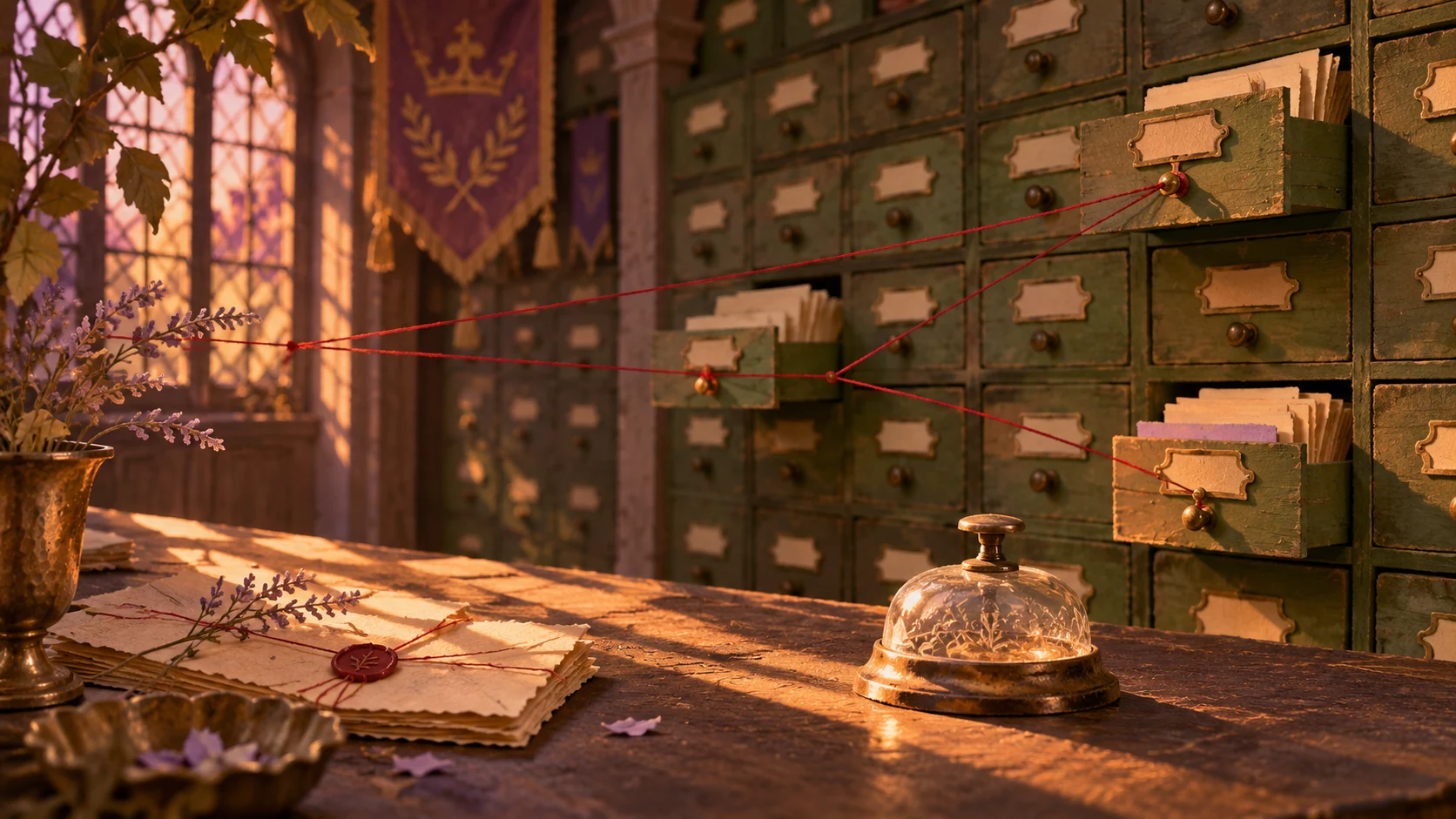
Foster is very good in this room. Alice asks her whom the school will call if the queen is unavailable. Celeste says she’s always available. A page asks her to step into the next room for a moment. Foster leaves the tiniest pause before telling him to stay where he is. Her idea of ruling depends on people asking for her and on no one asking where she was supposed to be before they asked. I wish the film had let her spend another five minutes with that bell. There’s an unfortunate rush here to show her taking somebody’s shadow when a lot of damage has already been done by the way she requests a chair.
The queen’s arrangement has one problem she’d been able to make somebody else’s. A child on an ordinary school day can go home when an adult who has signed for them comes to get them. Celeste has had the school day extended until everyone on her list comes back. This includes adults whose names were entered decades ago. Alice’s mother learned how to go home with Alice by signing a departure card and getting another adult to agree to stay at school. She left the return time blank to give the other woman a chance to work out how to get home on her own. Celeste had the unknown time filed as a continuing absence. The woman is now the one who waves people through without asking for their number.
The film could have let that be a story about Alice’s mother. It stays with Billie, who does the thing that gets her into trouble twice before this and makes up another rule. She’s been looking at the wrong place on the slip. At the bottom, under the space for a return date, it asks whether an activity is on school grounds. Alice has been trying to get a child out of one courtyard. Billie wants to see whether she can take the whole place on a field trip.
That phrase is the first thing that made me laugh out loud after the pencil scene. It’s delivered in complete seriousness, as of course it needs to be for Quill to write it down. Quire points out that they’ll need a second contact. Billie already has one. Downstairs, the glass bell starts ringing. We cut to Beef Roger asleep inside somebody’s bag. It takes him a while to open an eye. I would have been disappointed if the third had been the first to open.
He answers from outside. That turns the flat patch of stone beyond the arch into a destination, as far as the school is concerned. Alice has to put her own name down as the person in charge of the group and agrees to do it after checking that the two children she’s going with have room to cross. Celeste has to find a place on the sheet for herself. The only clear line left is where a parent can add a comment. She gets as far as writing the first letter of her name before a woman from the class asks whether she plans to come with them. In the glimpse we get of her face, she appears to have been waiting a long time for somebody to ask where she’d like to go.
I like almost everything in that sequence until the movie decides to show us four buildings at once. What’s striking about the attempt is how little of the city would actually have to move. There’s a bench just over the line. Billie chooses it because from there you can see the way back. Alice calls the attendance herself and hears a number of adults say “here” in the small voice they’d have used at nine years old. The music drops out on a shade tree while the registrar waits for her own name. I wish the shot stayed on her longer. There is one line Jones reads in the ordinary tone you’d use for a child you can see perfectly well, and it was enough to make the person next to me start looking for a tissue in the dark.
For all that build-up, getting back from the field trip takes one wag of an attendant’s finger. Mina says she wants to be taken to her own house. Alice offers to walk her there. The attendant calls them back, lays down the slip that had kept Mina on the other side, and crosses out the absence. It becomes an attendance slip again. He does the ordinary thing adult after adult has been too busy to do for her all day and waits for an answer while he looks her in the face. The film finally lets us get a good look at what Mina has been carrying in that satchel. It’s a spare cup. The first one is still by the bench, where she put it down before anybody started looking for her.
Back at the desk
I don’t think I needed all of the rules explained. I liked how much Billie got done by asking for a real answer to a real question. I liked that Alice could sometimes help by getting out of her daughter’s way. The script still wants to point this out late in the picture when they’re both standing there and we can hear how differently they’re talking to each other. Steinfeld and Jones sound like they know which parts of the other person’s sentence they can skip. I wanted a little more of the quiet that lets you notice that.
By the end we’re back in the office. The woman at the window is now sitting on the side of the glass with the chairs. She’s holding her own temporary pass. Alice has found the red ticket she took at the start and gives it to Billie, who hands it to the woman as if she’s being very helpful. It says 18. An unseen voice in the office calls 17. The woman and Billie take the next two seats. They look equally capable of waiting for something they have decided they want.
Four stars. I’d see it again. The print above the counter was too small for me to read from where I was sitting, and I’d like to know what happens if you lose the ticket.