We Stopped Letting Kids Play Violent Video Games And Now None Of Them Can Change A Tire Under Gunfire
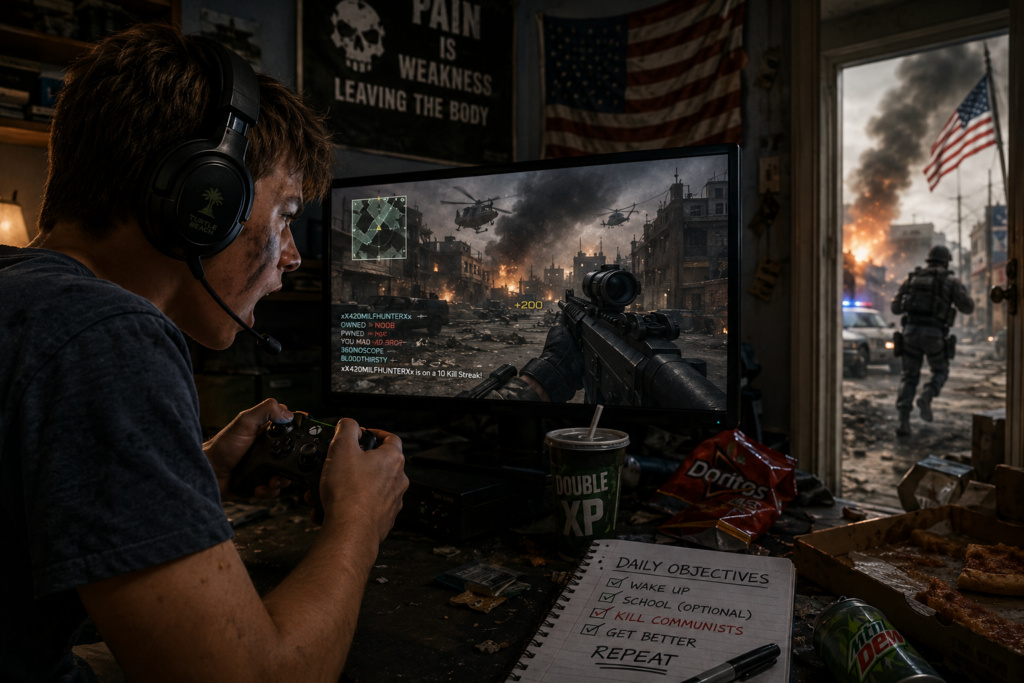
For twenty years, nervous pediatricians, suburban mothers, and men who still say “the Nintendo” have warned America that violent video games create violent behavior. According to them, every hour spent playing a first-person shooter pushes a child one step closer to becoming a dangerous criminal capable of horrific acts like vaping indoors or starting a cryptocurrency podcast.
Fine. Let’s say they’re right.
At least those kids used to know how to clear a room.
Modern America has become so obsessed with emotional safety that we have accidentally raised an entire generation incapable of surviving even the most basic societal collapse scenario. Ask a 14-year-old today to double jump across a collapsing bridge while carrying two assault rifles and a medkit and he’ll stare at you like you’re insane. Meanwhile, children in 2009 could do it instinctively while being screamed at by a stranger named xX420MILFHUNTERXx through a broken Xbox headset.
Those kids are now engineers.
There was a time in this country when a boy could spend 11 consecutive hours learning advanced urban combat strategy in a damp basement and people understood that was education. Today, schools waste valuable classroom time teaching emotional regulation and digital citizenship instead of the core competencies that once made this nation great, like memorizing every reload animation in Call of Duty: Modern Warfare 2.
Experts now estimate that the average American teenager can survive just six minutes in a post-apocalyptic wasteland before attempting to “process their feelings” with a mutant.
“This is what happens when society abandons controlled violence exposure,” said cultural analyst Dr. Brent Hollister while polishing a ceremonial Halo 3 helmet in his office. “The Romans had gladiators. Medieval Europe had public executions. America had 12-year-olds calling each other slurs in a Gears of War lobby. Every civilization needs a proving ground.”
Critics claim violent games desensitize players. Correct. That is the point.
A functioning adult should be able to hear at least three nearby explosions without crying or asking HR for a mental health day. Previous generations understood this. The average Xbox 360 teenager experienced enough simulated warfare to calmly continue eating pizza rolls while an AC-130 rained hellfire over a Middle Eastern airport. Now people have panic attacks because DoorDash forgot the dipping sauce.
Military leaders quietly admit the decline has become catastrophic. Recruitment numbers continue falling because Gen Z applicants struggle with basic combat concepts such as “being yelled at” and “walking toward gunfire instead of away from it.” One Pentagon official, speaking anonymously, admitted the armed forces are considering replacing boot camp with mandatory ranked multiplayer.
“Frankly, the old systems worked,” the official said. “Back then a 13-year-old in Ohio could absorb sustained psychological abuse from six adults in Belarus and still maintain objective focus long enough to plant the bomb.”
The softening of America did not happen overnight. It began gradually. First schools banned dodgeball. Then they eliminated tag because it involved “aggressive chasing.” Eventually the country decided children should no longer spend weekends chainsawing locust monsters in split-screen co-op with Mountain Dew running through their bloodstream like diesel fuel.
Now look at us.
Nobody can parallel park under pressure.
Nobody instinctively crouches when fireworks go off.
Half the population needs a weighted blanket after hearing constructive criticism.
Worst of all, modern young adults have completely lost the ability to endure minor inconvenience while pursuing meaningless objectives. Earlier generations willingly spent six straight hours trying to unlock a camouflage skin that made their gun 4 percent shinier. Today’s youth quit immediately if a phone app takes longer than three seconds to load. Civilization cannot survive without psychological resilience built through repetitive pointless suffering.
Naturally, opponents insist there is no evidence video games improve toughness. These are the same people who think society benefits from raising emotionally available men who can identify “burnout symptoms” instead of instinctively checking corners before entering the kitchen.
America used to produce hardened individuals capable of surviving racial slurs, sleep deprivation, and catastrophic internet lag simultaneously. The old Xbox Live ecosystem forged emotional durability in ways no therapist ever could. A child would enter a lobby at age eleven and emerge three years later with the survival instincts of a Balkan mercenary.
That is nation-building.
The solution is obvious. Violent video games should not merely return. They should become mandatory.
Every American teenager should be required to complete at least 400 hours of tactical online combat before receiving a driver’s license. History classes should include supervised Halo LAN parties. Final exams should involve defending a bomb site while a teammate screams incomprehensible profanity after dying immediately.
Will this create more violence? Possibly.
But it will also create men who can assemble IKEA furniture without needing to “take a minute.”