Opinion: Billy Madison Completely Distorted My Reality Of What The First Day Of School Would Be Like
The 1995 Adam Sandler film led me to believe the American education system was built around bus parades, dodgeball trauma, and adult millionaires repeating third grade.
I am ready to say something that may make the education lobby uncomfortable: Billy Madison completely distorted my reality of what the first day of school would be like, and no adult in my life ever had the decency to deprogram me before I walked through the gates with a backpack full of lies.
For years, the 1995 Adam Sandler film was presented to me as a harmless comedy about a rich adult man repeating every grade so he could inherit a hotel empire. What it actually did was construct an elaborate false consciousness around primary education, one in which every classroom was one public meltdown away from a montage, every bus ride had the moral force of a parade, and the entire school system existed to rehabilitate one unserious heir in cargo shorts.
That is a lot to put inside the head of a child with a fresh lunchbox and no legal understanding of satire.
By the time my actual first day arrived, I had built a complete educational worldview around Billy Madison. I believed the morning would begin with a grown man being enthusiastically reabsorbed into kindergarten while the rest of us looked on as minor supporting characters in his redemption arc. I believed there would be singing. I believed a bus driver would tolerate shouting. I believed the first day of school was less an administrative transition and more a full-contact civic ceremony.
Instead, my mother took a photo of me beside a brick wall, zipped my jacket up too high, and told me not to lose my hat.
This was the first betrayal.
The second betrayal was the bus. Billy Madison had led me to believe school transportation was a rolling celebration of youth, volume, and unresolved family money. My bus smelled like old vinyl and banana. The driver, a tired man named Glen, enforced seated silence with the grim patience of someone who had already seen three children try to eat erasers before 8 a.m.
There was no music. There was no camaraderie. There was no adult classmate in the back absorbing everyone’s attention by behaving like a divorced magician. There was just me, a boy named Patrick who claimed his cousin owned a knife, and a laminated sign warning us that throwing objects was a punishable offense.
I had prepared for a carnival and boarded a municipal tube of consequences.
The classroom was worse. In Billy Madison, school was a place where the laws of normal childhood kept giving way to absurd pageantry: dodgeball wars, cafeteria folklore, public humiliation, weirdly intense academic contests, and grown men sweating through moral lessons they should have mastered decades earlier.
My classroom had tubs.
Tubs for pencils. Tubs for scissors. Tubs for glue sticks with names written on masking tape. There was no sinister family business subplot. No one announced that passing first grade would allow them to retain control of a resort chain. The highest-stakes issue in the room was whether Declan could keep his hands out of the aquarium.
I kept waiting for the day to reveal its real structure. Surely after attendance, something would happen. Surely a teacher would explain that the first worksheet was only a warm-up before we were all sent outside for a legally questionable dodgeball tournament. Surely an adult millionaire would burst in, fall down, and reset the emotional temperature of the building.
Nothing happened.
We traced letters.
We colored a duck.
We sat on a mat while a woman with the calm, extinguished voice of a hostage negotiator explained where the toilets were.
Do you understand what that does to a child who has been promised Adam Sandler’s version of education? It creates a permanent gap between institutional reality and cinematic expectation. I did not experience school as school. I experienced school as a movie that had lost its nerve.
Lunch was another catastrophic adjustment. Billy Madison taught me that lunch was a social market full of status, danger, and adult-sized appetites. I expected the cafeteria to be a gleaming arena of deals, chants, and food-based character development. I expected someone to make a statement with pudding.
What I got was a plastic container of apple slices, a juice box that collapsed in on itself like a dying lung, and one cheese stick sweating inside cling wrap.
No one wanted to trade. No one respected my position on Snack Pack diplomacy. A teacher told us sharing food was not allowed because of allergies, which may have been medically correct but was emotionally devastating. By 12:15 p.m., the entire economic system Billy Madison had shown me was dead.
Recess did not save things. I had assumed recess would operate as a trial by violence, where the loudest child could become a small king by pelting someone in the head with a rubber ball. Instead, our playground had a buddy bench. The buddy bench was presented as a compassionate social tool, but to me it felt like an admission that the school had no intention of letting anyone become legendary.
I stood near the monkey bars, waiting for the O’Doyle family or any comparable dynasty to establish dominance. Three boys made a hole in the mulch with a stick. A girl named Amber said she had a blister. A duty teacher told me not to climb up the slide.
That was it. That was childhood.
The hardest part is that I could not explain my disappointment without sounding insane. If I told my parents school was not enough like Billy Madison, they looked at me as if I had misunderstood both school and movies, which, unfortunately, was true. If I told my teacher I was waiting for the plot to start, she gave me an extra coloring page and moved my peg to yellow.
No one wanted to confront the real issue: a major Hollywood comedy had allowed children to enter formal education believing first grade might involve a hotel fortune, a humiliating spelling challenge, and a grown man’s spiritual journey through paste.
This is why I am calling for accountability. Not censorship. Not outrage. Not one of those miserable little media literacy panels where everyone pretends children are supposed to understand genre. I am calling for a modest national support scheme for people whose first day of school was psychologically compromised by Billy Madison.
At minimum, every DVD, VHS tape, streaming tile, and dentist-office waiting room broadcast of the film should come with a plain-language warning: School will mostly be lining up. No adult millionaire will be there. Your teacher will make you wash your hands after touching a turtle. Dodgeball may not happen for several years and will be worse than advertised.
Adam Sandler does not need to apologize, but he should fund a helpline. Parents do not need to stop showing the movie, but they should sit children down afterward and say, clearly, that most schools are not operated as accelerated inheritance trials. Teachers should receive professional development on how to identify students who are waiting for the school day to become a montage.
Because some of us are still waiting.
Even now, decades later, I smell pencil shavings and feel the old confusion come back. I see a yellow bus and wonder why everyone is sitting down. I pass a cafeteria and instinctively look for a rich 27-year-old man attempting to win the respect of children. I know, intellectually, that school is mostly worksheets, bells, and adults saying “inside voices” until their souls leave their bodies.
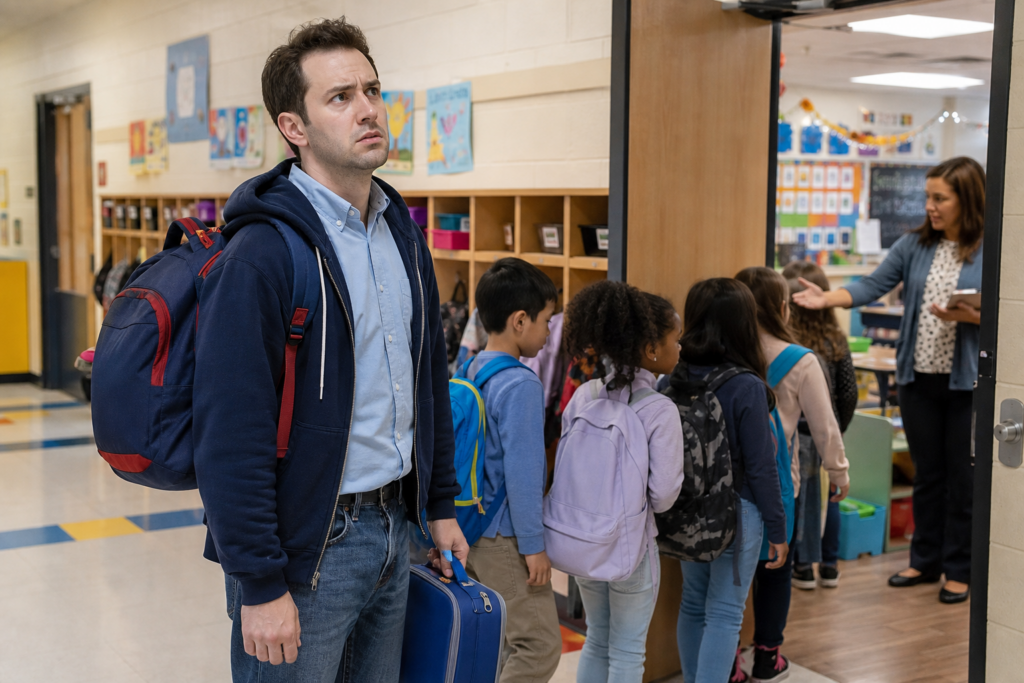
But part of me is still that child on the first morning, standing in a classroom full of labeled tubs, slowly realizing I had not entered a comedy about educational chaos.
I had entered school.
And somehow, that was much stranger.