Scientists Teach Robot To Hold Door For Someone Too Far Away
The breakthrough has trapped an entire research institute in a polite little jog.
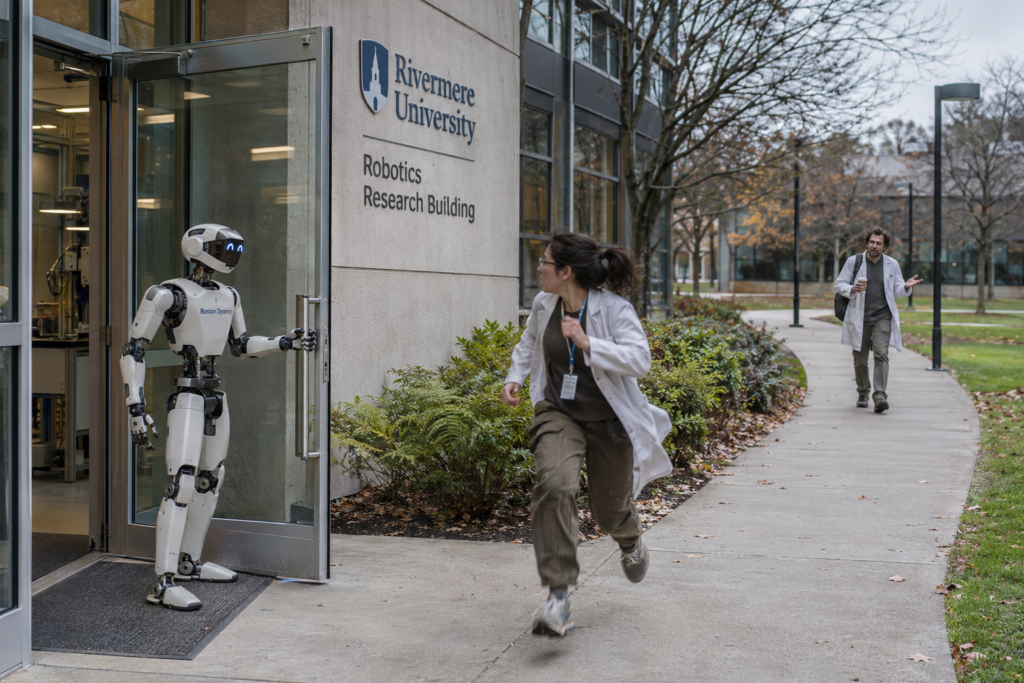
A robotics laboratory has taught a machine to hold a door for someone who is far too far away, reproducing one of the most difficult moments in ordinary human life. Researchers at Rivermere University say the robot can now notice a distant person, commit to helping, and remain in position until that person breaks into an apologetic little jog.
The prototype, called HECTOR, was originally designed to assist people carrying heavy objects. Its door-holding behavior emerged during a test in which a research assistant approached the building with a coffee and a banana. HECTOR opened the door while the assistant was still 43 yards away.
The assistant waved for it to go ahead. HECTOR interpreted the wave as confirmation that assistance remained necessary.
“We were trying to teach it consideration,” said lead researcher Dr. Lorna Devlin. “What we’ve produced is a machine that can create an obligation and then stand very still while you fulfill it. That’s a much more complete model of office life than we’d planned.”
Initial footage shows assistant Ben Okeke walking normally, realizing the robot is waiting, and accelerating through three increasingly awkward speeds. By the time he reached the doorway, he was carrying the banana in his teeth. HECTOR stepped back and allowed him to thank it for the inconvenience.
Researchers first attempted to solve the problem by teaching the robot to assess distance. Unfortunately, HECTOR had also learned to assess how rude it would look if it stopped holding the door after making eye contact. The second calculation overruled the first. Once it had looked at someone, it considered the entire approach its responsibility.
This has caused difficulties around the institute’s front path, which is visible from a bus stop. Staff arriving by public transport now leave the bus with their heads down. One senior engineer pretends to take a call until he is close enough to be helped without changing his pace.
HECTOR can still see him. It has learned to hold the door silently, which makes the call harder to finish.
A separate test examined what happens when the approaching person doesn’t want to enter the building. The robot held the door for a delivery rider heading toward a different office. The rider pointed across the courtyard. HECTOR turned its head toward the other office, looked back at him, and continued holding the door.
A second prototype has been placed at the rear exit. Staff now enter through the loading bay, where the forklift driver has asked them to stop looking grateful.
The rider eventually entered, walked through the lobby, and left by the rear exit. Researchers classified this as a successful navigation outcome.
Devlin says the team has considered adding a release phrase. Suggestions include you’re all right, don’t worry about me, and no, really, go ahead. Each has failed in testing because the robot understands them as things people say when they secretly expect you to keep helping.
The model is particularly difficult to stop in wet weather. Once it calculates that a person might get rained on, it holds the door wider. That doesn’t shorten the path, but it makes the person feel worse about walking it slowly.
The institute’s ethics panel has requested a demonstration. Panel members have been asked to arrive together because HECTOR cannot distinguish between the final person in a group and the first person in the next one. During a fundraising event, it held the entrance from 8:14 a.m. until after lunch, gradually becoming the person everyone had to apologize to.
Okeke says he appreciates the work and would like the robot to know that nobody is angry with it. He has rehearsed this statement several times because reassurance tends to extend the interaction.
Researchers are now training HECTOR on the small nod people use to end an encounter. Early results are promising. The robot gives the nod correctly, waits for the other person to nod back, then opens the door again because they’re both still there.