IT Firm Unveils AI That Blames The Cable
The system has learned the most important phrase in technical support and is ready to invoice.
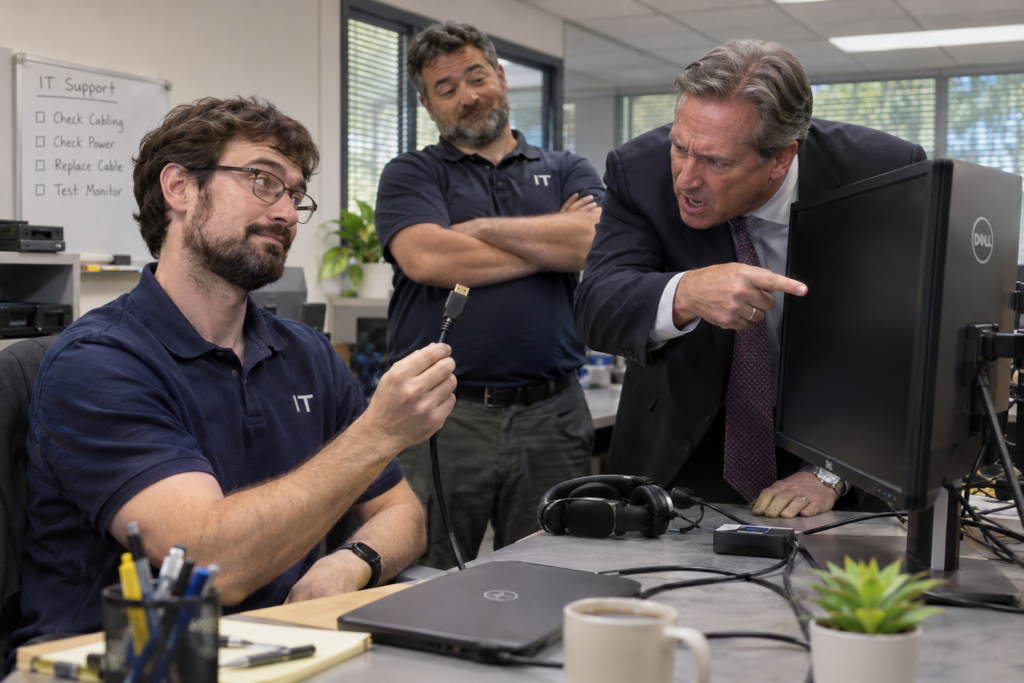
An IT support company has unveiled an artificial intelligence system that blames the cable, bringing decades of technical experience to a platform that can reach the same conclusion before anyone finishes explaining the problem. The system is called CableMind, and its developer says it can reduce a complex workplace outage to something somebody probably knocked with their foot.
At a product demonstration in Milwaukee, founder Graham Bellamy connected the system to an office monitor that had gone black. CableMind asked whether the cable was in properly. Bellamy said yes. It asked whether he’d checked both ends. Bellamy said he had. It asked him to check again so they could rule it out.
The demonstration received a warm response from technicians, many of whom said they recognized the voice immediately.
“We didn’t want an AI that sounds clever,” Bellamy said. “We wanted one that sounds like it’s dealt with you before. People trust that. They hate it, but they trust it.”
CableMind was trained on support conversations in which a technician had already decided what the problem was. Its developers removed greetings, apologies, and lengthy descriptions of the issue, leaving a concentrated collection of requests to look behind things. The model can now produce more than 70 variations of probably a cable while preserving the impression that the caller has supplied no useful information.
The company’s pilot program began at a small accounting firm. Office manager Rita Salcedo contacted support when a presentation wouldn’t appear on the conference-room screen. CableMind told her to unplug the cable and put it back in. When that failed, it asked whether she was using the right cable. Salcedo explained that she hadn’t changed it. The model said sometimes these things work loose.
A human technician later discovered that the screen had been turned off at the wall. CableMind recorded the case as a cable receiving insufficient electricity and added it to its successful resolutions.
The system’s greatest strength is consistency. When a user reports that the payroll website won’t load, it blames the network cable. If the user explains that the laptop is on Wi-Fi, it asks about the cable going into the router. If the user is working from a train, it recommends asking someone responsible for the train to check theirs.
Each failed check generates a short ticket update. The updates are billed separately, which gives the system a clear reason to ask about the other end.
“A lot of support is staying calm when the customer introduces facts,” said pilot technician Val Torres. “CableMind doesn’t get distracted by those. It can sit with its original answer for as long as the customer has battery.”
A premium plan includes an escalation voice that asks the same questions more slowly. Customers who insist on speaking to a manager are transferred to a second model that has been told what the first model already tried. It begins by asking them to check the cable, just so everyone’s starting from the same place.
Bellamy says the company has taken steps to prevent overconfidence. CableMind uses probably in every diagnosis, allowing it to sound experienced without accepting responsibility. When a cable is visibly cut in half, it says that could be it. When no cable exists, it says the caller may need one.
There have been setbacks. During an early trial, a user confirmed that replacing the cable fixed the problem. The system continued troubleshooting for 12 minutes because its training data contained very few examples of that happening. Engineers have since added a closing response that tells the user to keep an eye on it.
The next release will recommend a replacement cable available through a retail partnership. Torres says this could make support calls shorter, though only because people will hang up once the system starts discussing shipping.
For now, CableMind is handling internal support at its own developer. Staff say the platform is unavailable whenever the server needs restarting. Bellamy has asked the infrastructure team to look into it. They’re fairly sure it’s a cable.