I Run This Book Club Without Reading The Books
Someone has to lead the discussion, and the people who read chapter twelve keep getting distracted by what happened in it.
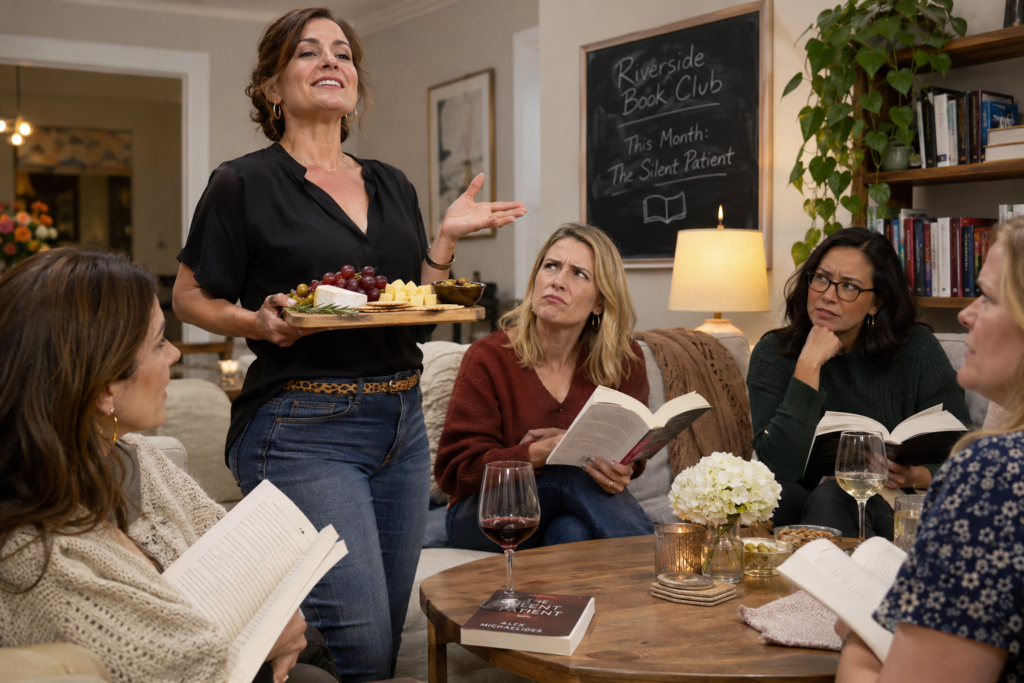
I run a successful book club, and I have never let finishing the book interfere with that. The guests arrive, the chairs are out, and there is something on the table that required me to wash a wooden board. By any sensible measure, the evening is ready. Then Leanne starts asking about chapter twelve.
Leanne has read chapter twelve. She’s also read the other chapters, which she brings up in a way that makes those of us responsible for the cheese feel unwelcome in our own homes. I don’t think literary discussion should be reserved for people with that much spare time.
I have a job. I have a husband who needs to be told when something in the fridge has become a science project. I cannot devote every evening to a woman in a novel walking toward a lake when I already have a woman in my group chat asking whether we’re meeting at seven or seven-thirty. The novel can wait. Someone has to settle the time.
My approach is to come prepared with a larger question. What is the author trying to say about belonging? This works with most books. If the main character leaves somewhere, they’re looking for it. If they stay, they’re struggling with it. If they die, I ask whether they ever found it. People usually need a moment after that, during which I can refill my glass.
Sometimes Leanne tries to connect my question to a specific passage. I let her read the passage because I believe in participation. Then I ask whether she thinks the author needed all those words. She says they’re the words in the book. I say exactly, and let the silence do its work.
I’ve been told I interrupt too much. Our treasurer, Leanne Sosa, said, “We could hear what everyone thought if you’d let us get past the cover.” I found that revealing. She wants to rush past the first artistic decision the author allowed us to see. I spent several minutes explaining why the cover was green. Leanne said the protagonist is a botanist. Fine. That could be part of it.
There are benefits to remaining independent of the plot. Once you’ve read a book, you become invested in what happened. You start correcting people. A woman will offer a perfectly useful observation about the husband’s jealousy, and someone will say there is no husband. Well, then we should be discussing why the absence felt so strong to her. We don’t need to make her feel stupid. I was the woman, and it was an excellent observation.
My husband says I could listen to the audiobook. I tried that. The narrator kept talking while I was deciding how to respond, and by the time I’d formed an opinion the family had moved to another house. I had to go back. Then I heard a detail that contradicted what I wanted to say at the meeting. The whole arrangement was unhelpful.
I do read reviews. They provide the important information in a form that respects my evening. I avoid mentioning the reviews in discussion because I want the group to encounter the ideas without being distracted by who originally had them. This also lets me say the ending felt unearned before anyone reveals what it was.
Last month, Priya suggested a meeting at her apartment. I supported that until she said everyone could bring one passage they wanted to discuss. She had effectively made a ticketed event, with a piece of reading as the admission price. I asked whether people without a passage would still be welcome. She said yes, of course. I could tell what the of course meant.
I went anyway. Priya had a board too, with better olives than mine. We spent 40 minutes discussing the book without anybody asking me to open a second bottle. I began to worry the group could function without my contribution, so I asked whether the author was reliable. Priya said I meant the narrator. I said I meant both. That took care of another quarter hour.
We’re back at my place next month. I’ve chosen a short book because several members have been making the workload sound unreasonable. Leanne says it is the first volume of a trilogy. I told her I wasn’t interested in setting limits on where the conversation could go. I’ll be putting out the good crackers, and I expect a little less hostility about what everyone has done with their evening.