Finally: Police Doing Their Jobs By Tackling Student Before She Could Finish Anti-Poverty Lunch
Police restored public confidence by arresting a 21-year-old anti-poverty activist during lunch before she could finish eating and continue believing poor people should have money.
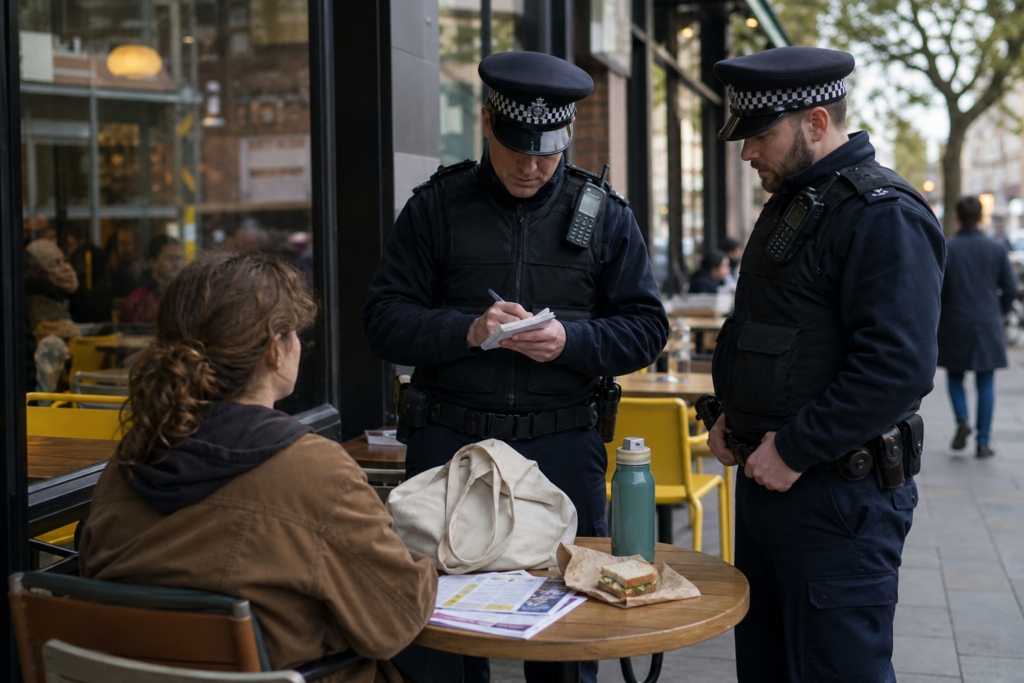
LONDON – Restoring public confidence in law enforcement after years of criticism that officers have failed to focus on the nation’s most urgent threats, Metropolitan Police confirmed Tuesday that they successfully arrested a 21-year-old anti-poverty activist during her lunch break before she could finish eating and continue believing poor people should have money.
Witnesses said the student, identified in footage only as Ella, was seated near a café with the dangerous combination of a young person’s face, a social conscience, and enough free time between obligations to briefly oppose deprivation. Officers moved in after determining she was at high risk of returning from lunch with the same views she had before lunch.
“This is exactly what the public expects from modern policing,” said Acting Superintendent Martin Vale, standing beside a table of seized evidence that included a tote bag, a half-wrapped sandwich, two leaflets, and one reusable water bottle believed to be full of dangerous civic concern. “For too long, people have been asking when police would get serious about crime. Today we can say clearly: we found a student who thinks poverty is bad, and we did not let her just sit there.”
Vale said officers had acted with “proportionate urgency” after receiving reports that someone in the area may have been using a lunch break for something other than checking email, buying soup, or staring blankly at a phone until capitalism resumed.
“Lunch is one of the most volatile parts of the day,” Vale said. “A person has eaten just enough to regain hope but not enough to fall asleep. That creates a narrow window where anti-poverty sentiment can spread.”
According to police, the arrest formed part of Operation Reasonable Priorities, a new initiative targeting the most destabilizing forces in public life: people with handwritten signs, students who know what rent costs, pensioners holding banners, and anyone carrying a sandwich while saying “social safety net” within 30 feet of a chain café.
“We cannot have ordinary shoppers being exposed to these ideas without warning,” Vale added. “One minute you’re buying a latte, the next you’re wondering why a country with billionaires also has food banks. That is how disorder begins.”
Café customers described the scene as alarming but ultimately reassuring. Several said they had noticed the activist speaking calmly before police arrived, which only heightened concerns.
“She didn’t look violent, and that made it worse,” said commuter Helen Marsh, who had been trying to enjoy a cappuccino in the moral quiet of not thinking about anything. “If someone is shouting, you know where you stand. But she was just there on the ground saying her name and age, like poverty might involve actual people. I found that very confrontational.”
Marsh praised police for preventing the café from becoming “political,” a term she defined as “anything that makes a meal deal feel implicated.”
Another witness said officers were right to act quickly because lunch breaks are a known gateway to radicalization.
“First it’s anti-poverty activism on your lunch break,” said local office manager Simon Preece. “Then it’s asking why landlords have more legal protection than tenants. Then suddenly everyone wants the council to fix things. Where does it end? A country?”
Police declined to confirm whether the activist’s sandwich had been confiscated, though sources said it was being examined by specialists for traces of hummus, class consciousness, and intent to assemble.
Government officials welcomed the arrest, calling it proof that public order laws are working exactly as designed by making sure the most heavily monitored people in society are those least likely to own a second home.
“The right to protest remains sacred,” said a Home Office spokesperson. “But it must be balanced against the equally sacred right of nearby diners to complete a £7.80 toastie without hearing that poverty exists.”
The spokesperson added that Britain has a proud democratic tradition in which citizens are free to raise concerns through proper channels, such as online consultations no one reads, parliamentary petitions that expire quietly, or thinking about injustice at home where it cannot obstruct a pavement.
“We encourage young people to engage with politics,” she said. “Ideally through voting once every five years, feeling disappointed, and never causing a police scheduling issue.”
Legal experts said the arrest raises important questions about how far authorities can go in protecting the public from the spectacle of a young person having values during daylight hours.
“The law has always recognized the danger of lunch,” said barrister Anita Croft. “Breakfast activism is usually too undercaffeinated to matter. Dinner activism is trapped in group chats. But lunch activism occurs in public, near witnesses, after glucose has entered the bloodstream. It is the constitutional gray area police have been waiting for.”
Croft said the case could establish a new standard under which officers may intervene whenever an activist appears capable of finishing a sandwich and returning to society with unresolved moral clarity.
“If the courts uphold this, it gives police a powerful tool,” Croft said. “They will no longer have to wait for a protester to block a road, climb a building, or make anyone late. The mere presence of a young person thinking about poverty while chewing could be enough.”
By Tuesday evening, senior police sources said the operation had already delivered results. Officers had identified three additional lunch-break risks, including a nurse reading a housing report, a teacher shaking her head at an energy bill, and a man in a Pret queue who said “something has to give” with suspicious sincerity.
All three were warned to finish their food in a less socially aware manner.
Police said they remain committed to pursuing serious threats wherever they appear, including cafés, campuses, pavements, and any public space where a person under 25 might briefly confuse democracy with participation.
“People say the police don’t do anything anymore,” Vale said. “But today, thanks to swift action, one student did not complete lunch in peace while opposing poverty. That is what keeping Britain safe looks like.”