A Win For Equality: Nando’s Replaces Every Toilet With Gender-Neutral Urinals
Nando's Australia is piloting gender-neutral urinals by removing every toilet from select restaurants, calling the bad room a win for equality.
SYDNEY – In a landmark victory for restaurant inclusivity and a catastrophic development for anyone who needed to sit down for even one private second, Nando’s Australia has announced that it will begin removing all toilets from select restaurants and replacing them with gender-neutral urinals. With the plan to eventually roll it out to all stores.
The beloved peri-peri chicken chain said the pilot program, currently rolling out across several Australian states, will ensure customers of every gender have equal access to the same confusing porcelain wall trough after smashing half a chicken, spicy rice, and a large Coke Zero.
“For too long, restaurant bathrooms have divided people into outdated categories such as men, women, families, people with stomach cramps, and customers who made a serious mistake with extra hot sauce,” said Nando’s head of inclusive facilities Tessa Cramb. “Our new model says no matter who you are, there is one option, and that option is a urinal.”
Cramb called the move “a win for equality,” explaining that the company had grown uncomfortable with restroom layouts that offered different fixtures to different customers based on anatomy, comfort, mobility, clothing, urgency, or the basic human desire for a door.
“Equality means everyone getting the same experience,” Cramb said. “And the same experience is now standing in front of a wall-mounted bowl while a speaker plays soft Afro-Latin dining music and someone outside knocks because their wrap is getting cold.”
According to Nando’s, the new bathrooms will feature a clean, modern row of identical urinals beneath warm lighting, plus a single decorative plant intended to create a “welcoming, all-gender splash zone.” Traditional stalls will be removed to improve visual openness, reduce maintenance costs, and discourage what the company described as “lengthy, exclusionary toilet behavior.”
“Stalls create hierarchy,” Cramb said. “Some guests have privacy. Some guests do not. Some guests can sit. Some guests stand. We asked ourselves: what if nobody had privacy and everybody had to figure it out together?”
The pilot began after internal research found younger customers wanted brands to reflect their values but did not specify that those values should include working toilets.
“People told us they wanted gender-neutral bathrooms,” said Nando’s customer insights director Mark Pell. “We listened carefully to the first half of that phrase and moved very quickly before anyone could explain the second half.”
Pell said the company considered installing fully enclosed single-user bathrooms before executives determined that would be “too expensive, too practical, and insufficiently disruptive for a LinkedIn post.”
“A private toilet anyone can use is one approach,” Pell said. “But a row of urinals anyone can be disappointed by has much stronger brand energy.”
Customers at the first pilot location in Melbourne were divided, with some praising the company’s commitment to progress and others wondering how exactly they were supposed to handle the next four minutes of their life.
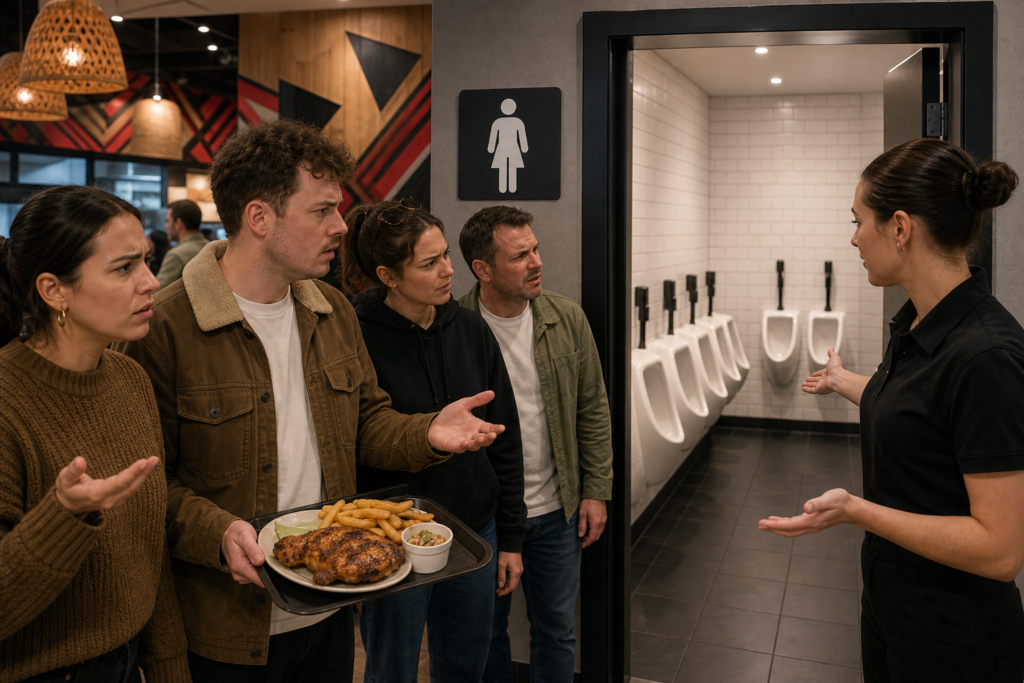
“I support equality,” said 34-year-old customer Jess Marlow, holding a tray of chips and staring into the newly renovated restroom with the calm horror of a person reading the terms of a parking fine. “I just thought it might involve more toilets.”
Marlow said she initially assumed the urinals were part of a men’s room, only to be told by staff that they were “for everyone now” and that Nando’s was “excited to learn alongside guests.”
“That’s not a bathroom policy,” Marlow said. “That’s a hostage situation with hand dryers.”
Another customer, builder Aaron Kells, said he appreciated the simplicity of the change but worried the restaurant had overshot the brief.
“I’m not against it,” Kells said. “A urinal’s a urinal. But my missus came in for a chicken pita and left asking if Nando’s had declared war on chairs.”
Kells said the policy could prove especially challenging for customers wearing jumpsuits, maxi dresses, motorcycle leathers, work uniforms, or any outfit not designed by a committee of men who believe belt loops are infrastructure.
“Even I can see there’s a logistics issue,” he said. “And I once used a traffic cone at a bucks party.”
Accessibility advocates criticized the pilot, noting that removing toilets would make Nando’s bathrooms unusable for many disabled customers, parents with children, older diners, people who need to sit, and anyone whose body does not operate according to a fast-casual renovation memo.
“This is not inclusion,” said public facilities consultant Lena Worth. “This is one fixture wearing a progressive hat.”
Worth said the company had confused equal treatment with identical inconvenience, a common corporate error that occurs when a workshop produces a slogan before anyone checks whether customers can physically use the room.
“If everyone is unable to use the bathroom in a different way, that is not fairness,” Worth said. “That is just a bad room.”
Nando’s said it will address accessibility concerns by adding QR codes near each urinal that link to a page titled “Your Journey Matters,” though the page does not appear to contain a toilet.
The company also plans to train staff to answer common customer questions, including “Where are the toilets?”, “No seriously, where are the toilets?”, “What am I meant to do with a toddler?”, and “Why is there a fern watching me?”
“We know change can be uncomfortable,” Cramb said. “That is why our team members will be allowed to say, ‘We hear you,’ while pointing at the same urinal again.”
Restaurant analysts said Nando’s may be attempting to generate social-media attention by combining a culture-war issue, a facilities downgrade, and the Australian public’s deep willingness to argue about bathrooms while eating chicken.
“From a marketing perspective, this is very efficient,” said brand strategist Joel Rinder. “You upset conservatives, confuse progressives, terrify parents, and somehow get tradies doing bathroom philosophy in the comments. That’s four demographics for the price of one plumbing disaster.”
Rinder said the move could inspire copycats, predicting Grill’d may replace every chair with an inclusive standing plank while Zambrero introduces a “gender-neutral napkin” that is just one communal towel on a hook.
At press time, Nando’s had already updated its app to help customers find participating locations, though the filter is reportedly labeled “Bathrooms: brave.”