Canberra Urges Australians To Prioritize Downhill Trips As Fuel Crisis Drags On
With the national fuel plan still at Level 2, the government has released voluntary guidance asking households to consider route gradients before using scarce fuel.
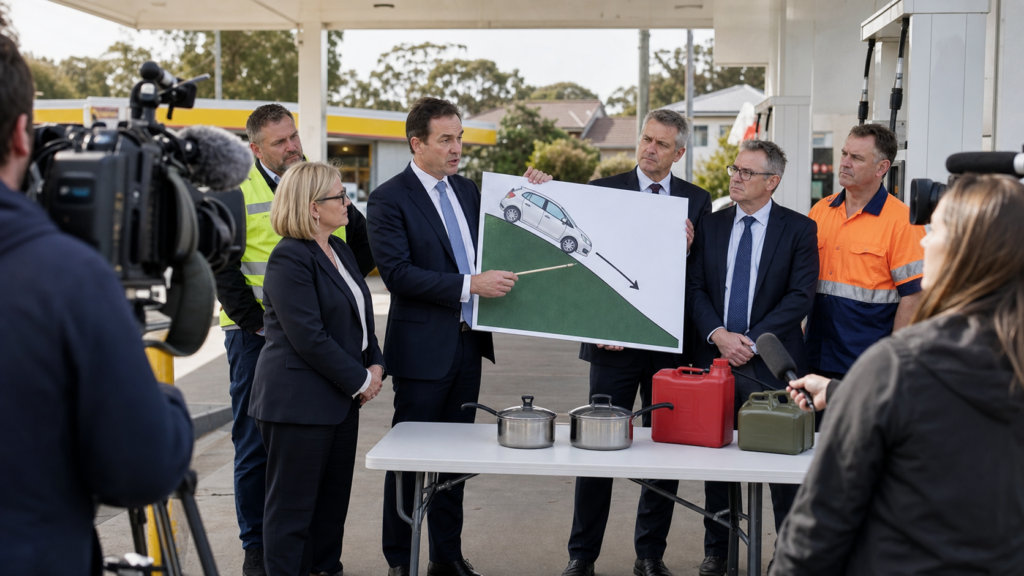
Australians have been told to make “practical, household-level adjustments” to fuel use as the national supply crunch continues, with new Commonwealth guidance encouraging motorists to consider whether a trip can be completed downhill before using petrol or diesel on less efficient routes.
The 18-page advisory note, released late Tuesday by the Fuel Supply Taskforce, does not impose rationing, restrict retail purchases, or add any new domestic fuel supply. Instead, it asks households, councils, schools, small businesses, and “journey organizers” to reduce avoidable engine load through what officials described as gradient-aware trip planning.
Under the voluntary guidance, motorists are advised to “prioritize naturally descending travel corridors where practical,” combine errands into one directional journey, avoid unnecessary climbs during peak fuel demand, and postpone non-essential uphill travel until “market conditions normalize.” The document notes that downhill travel may reduce fuel consumption in some vehicles, depending on speed, braking, road conditions, vehicle weight, and whether the driver eventually needs to return.
“No Australian is being told they cannot drive uphill,” said Bronwyn Phelps, acting deputy secretary for liquid fuel resilience, at a press conference outside a petrol station in suburban Brisbane. “We are simply asking people to look at their normal travel patterns and ask whether gravity can make a modest contribution before the Commonwealth has to consider less preferred interventions.”
The announcement comes as Australia remains at Level 2 of the National Fuel Security Plan, with the government insisting fuel continues to arrive despite global disruption, higher diesel costs, and concern about the country’s narrow refining base. Current official figures show 42 days of petrol reserves, 35 days of diesel, 29 days of jet fuel, and 45 clean-product tankers on the water.
Phelps said the figures showed there was “no immediate need for panic buying,” but conceded the government wanted to “send a clear demand-side signal” while shipping schedules, refinery operations, and wholesale prices remain under pressure. Asked whether the new guidance represented a material fuel security measure, she said it was “a practical behavioral document.”
“People hear ‘fuel security’ and immediately think of tankers, reserves, refineries, excise, freight corridors, and emergency stockholding,” Phelps said. “Those are obviously part of the picture. But there is also the question of whether a family in Toowoomba really needs to go back up the range for one HDMI cable.”
The guidance recommends councils publish simple “low-load local movement maps” showing residents which community facilities can be reached with minimal throttle input. It also suggests schools review whether afternoon pickup zones can be moved to the downhill side of campus, provided pedestrian safety, bus access, and “reasonable parental confusion” are taken into account.
For households in flat suburbs, the taskforce recommends trip chaining, tire pressure checks, avoiding roof racks, removing unnecessary weight from the boot, and “identifying any nearby ramps, overpasses, or shopping center exits that may provide short-duration descent benefits.”
The ACCC is expected to keep monitoring the fuel market after receiving thousands of complaints since March, including allegations of misleading price displays, unusual surcharges, and retailers failing to pass on the temporary 32 cent per liter fuel excise cut quickly enough. The downhill guidance does not include any new enforcement powers.
Fuel retailers welcomed the announcement cautiously, saying route choice was ultimately a matter for consumers, government, road planners, and anyone else who might be available. Several major operators said they would continue cooperating with authorities while reviewing whether “terrain-related demand event” should be added to customer receipts.
The new advice will sit alongside existing fuel security measures, including extra diesel and jet fuel cargoes, expanded stockholding, support for the country’s two remaining refineries, and repeated assurances that motorists should avoid panic buying. No additional refinery capacity, retail price cap, household fuel allowance, or freight priority scheme was announced Tuesday.
Transport economist Dr. Helen Varcoe said the proposal was technically defensible in the narrowest possible sense, because reducing acceleration and engine load could save fuel. “The issue is not whether downhill driving uses less fuel,” Varcoe said. “The issue is that a national fuel resilience plan has reached the point where an official can say that into a microphone and still be the most serious person in the car park.”
Phelps rejected suggestions the government was shifting responsibility for the crisis onto households, saying the guidance was only one part of a broader national effort that also includes monitoring, messaging, and “maintaining an active watching brief.”
“We are doing everything available to us at this stage,” she said. “At present, the most available thing is asking people not to drive up hills unless they have thought about it first.”
At press time, the taskforce was preparing supplementary advice for aviation, including a recommendation that passengers choose flights with “favorable descent characteristics” where carrier schedules permit.