Australia Needs More Negative Gearing

CANBERRA, AUSTRALIA: As the nation continues to grapple with housing affordability, rental stress, and the growing suspicion that a three-bedroom fibro in Parramatta should not cost the same as a private island with plumbing, policy experts have reached an unexpected conclusion: Australia does not have enough negative gearing.
The finding comes after years of public debate in which critics claimed negative gearing allowed wealthier investors to reduce their taxable income while buying up existing homes. However, a new report from the Institute for Sensible Landlord Feelings argues the real problem is that too few Australians are being encouraged to lose money on properties they do not live in.
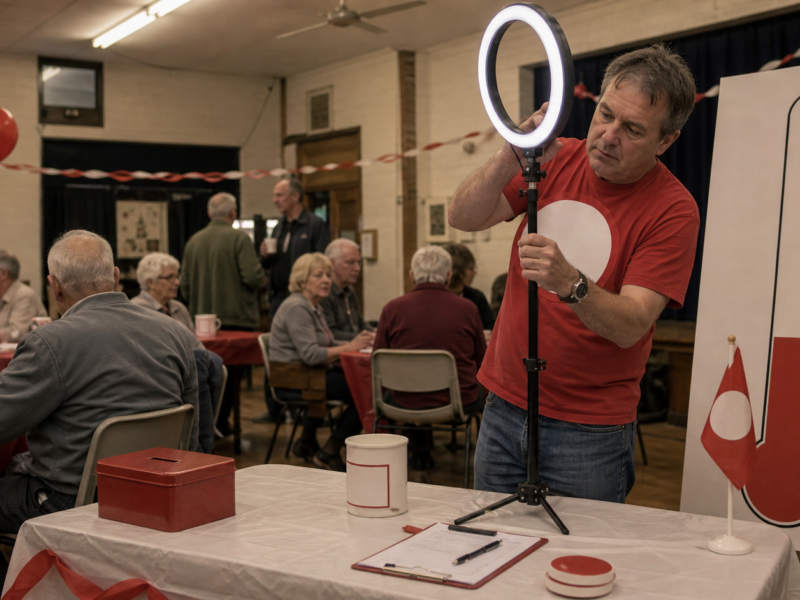
“For too long, negative gearing has been unfairly restricted to people with enough capital, borrowing capacity, and emotional numbness to purchase investment properties,” said report author Graham Hensley, speaking from a heritage-listed terrace he described as technically a workplace. “That is not equality. That is gatekeeping.”
The report recommends expanding negative gearing to every Australian, including renters, children, pensioners, pets, and individuals who once looked at a Domain listing for more than eight seconds.
Under the proposed system, Australians would be allowed to deduct hypothetical rental losses from their taxable income, provided they can prove they had a sincere intention to become a landlord at some point before death.
“This is about aspiration,” Hensley said. “A 27-year-old nurse in Brisbane may not be able to buy a unit, but she can still negatively gear the emotional loss of imagining she owned one.”
Treasury officials are reportedly reviewing the proposal after concluding it was no more deranged than the existing housing market. One senior official said the plan could restore confidence by giving all Australians the opportunity to participate in the national tradition of treating shelter as a spreadsheet with curtains.
“We have heard young people say they want homes,” the official said. “But what they really need is exposure to tax-effective disappointment.”
The proposal has been welcomed by property investors, who say Australia’s housing debate has unfairly demonised ordinary mums and dads who only own eight properties, a duplex, two negatively geared townhouses, and a beach shack that has never been occupied by anyone except an Airbnb guest named Trent.
“I’m not rich,” said Sydney investor Malcolm Vane, who owns several homes in suburbs he cannot pronounce without checking his conveyancer’s emails. “I’m just a battler with assets, leverage, tax minimisation strategies, and a family trust named after my boat.”
Vane said the public misunderstands negative gearing.
“People think I’m making money from housing,” he explained. “Actually, I’m losing money in a very profitable way. That takes discipline.”
According to the Institute, Australia’s hostility toward landlords has reached crisis levels, with many investors now forced to endure hurtful remarks such as maybe people should be able to buy a home to live in and why is your third property subsidised by someone’s income tax.
The report warns that without stronger negative gearing incentives, some investors may sell properties to owner-occupiers, causing the catastrophic spread of residential stability.
“If tenants become owners, who will landlords be?” Hensley asked. “You cannot just erase an entire cultural class because people want kitchens.”
The Real Estate Productivity Commission, an industry body formed inside a Mercedes dealership during a long lunch, has backed the report’s call for reform. It says Australia must stop viewing housing as a human need and return it to its proper role as a tax environment occasionally interrupted by families.
Commission chair Denise Arkwright said the current system does not go far enough.
“At present, investors can only claim losses on real properties they actually own,” Arkwright said. “That is a narrow, outdated model. We believe Australians should be able to claim losses on properties they nearly bought, properties they were outbid on, properties their uncle mentioned at Christmas, and properties that would have performed well had they existed.”
The plan includes a new deduction called the Landlord Potential Offset, allowing taxpayers to subtract up to $18,000 a year for the psychological burden of not yet owning an investment property.
It would also introduce negative gearing for open homes, meaning attendees could deduct petrol, coffee, linen shirts, silent resentment, and the time spent pretending not to overhear the auction guide was fake.
Housing advocates have criticised the proposal, arguing it would further inflate prices and reward speculative behaviour. But supporters dismissed those concerns as typical renter pessimism.
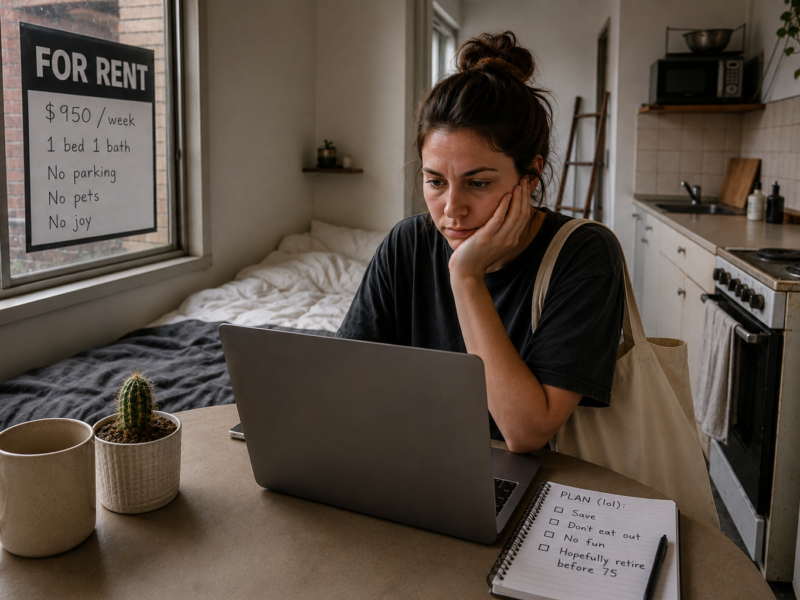
“Every generation has had challenges,” said Arkwright. “My parents had interest rates of 17 percent. Young people today have to live in a converted laundry with three strangers and a mould issue named Daniel. That is simply their version of sacrifice.”
The report also calls for a national education campaign to improve the image of landlords, including school programs teaching children that rent is not a cost but a monthly thank-you note to capital.
In one proposed Year 5 activity, students will be given a box of crayons and asked to draw the property ladder. Any child who draws themselves on it will be referred to a financial literacy counsellor.
A separate civics module will explain that Australia has three branches of government: executive, legislative, and negatively geared.
The Institute has further recommended renaming landlords as Housing Providers of Last Resort, except when they are raising rent, at which point they will be known as market participants experiencing yield trauma.
“Language matters,” said Hensley. “When a tenant pays $720 a week for a damp two-bedroom apartment near a train line, that can sound exploitative. But when you describe it as supporting a small investor’s retirement dream, suddenly it becomes community service.”
Banks are also expected to benefit from the expansion, with one major lender already preparing a new product called the First Home Investor Loan, aimed at Australians who cannot afford a home but may be eligible to purchase the concept of someone else living in one.
A spokesperson said the product would give young people a path into the market without requiring them to engage in outdated fantasies such as occupancy.
“Home ownership has evolved,” she said. “In the old days, you bought a home and lived in it. Today, with innovation, you can buy a worse home, rent it to someone poorer, lose money on paper, claim a deduction, and continue living with your parents. That is progress.”
The proposal has attracted quiet interest in Canberra, where several MPs are believed to support anything that contains the words housing supply, mums and dads, and grandfathered arrangements.
One adviser close to the discussions said the policy could be politically difficult but spiritually Australian.
“People say they hate negative gearing,” the adviser said. “But they also hate missing out. Our polling shows voters oppose investor tax concessions until they believe they might one day receive them, at which point they become the backbone of the federation.”
To address fairness concerns, the Institute has proposed a universal national target: by 2035, every Australian should own at least one property they cannot afford and feel morally attacked when asked about it.
The report concludes that Australia’s housing crisis will not be solved by building more homes, reducing speculation, reforming tax settings, or allowing wages to exist in the same conversation as prices. Instead, it says the nation must recommit to the principle that the only way to fix a broken ladder is to add more landlords standing on the rungs.
At a press conference announcing the report, Hensley rejected suggestions the policy would make housing even less affordable.
“That assumes houses are for living in,” he said. “We need to move beyond that kind of twentieth-century thinking.”
He then unveiled a pilot program allowing renters to deduct 30 percent of the rent they pay from the taxable income of their landlord, calling it the first truly bipartisan housing policy because both sides would hate it for different reasons.