Neighbor Asks City to Define ‘Curb’ Without Pointing at His House
The cart was close enough to the curb to be in the photo. Its owner would like to know how much farther it could have gone.
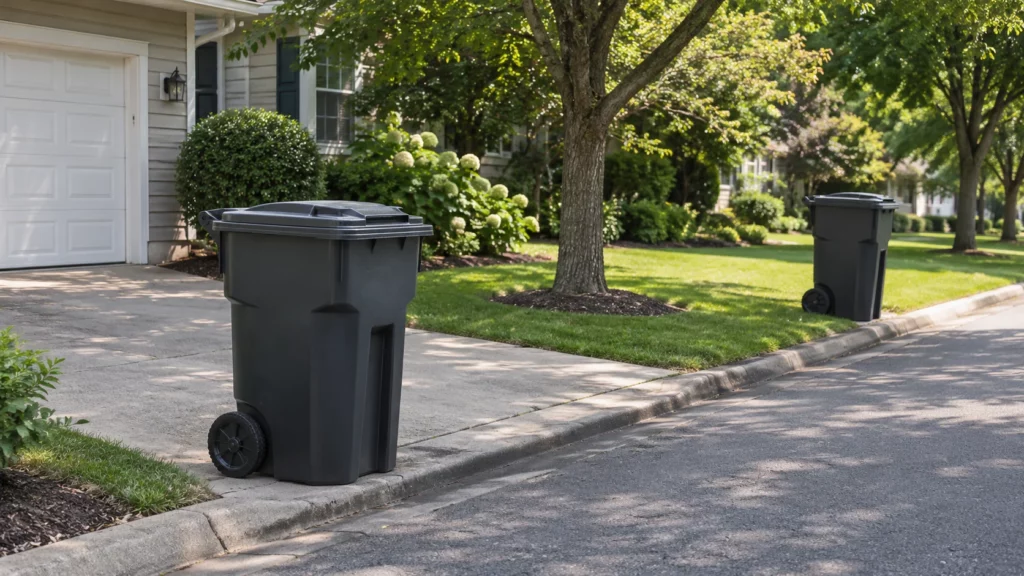
A man who received notice that his trash cart was positioned incorrectly has asked the city to define the curb without pointing at his house.
The notice included a photograph of the cart and a paragraph directing its owner to put it at the curb. The photograph shows a cart, the end of a yard, and a section of street Keith Owen believes he can identify. The paragraph says that a cart should be placed where it can be serviced. Owen is hoping to find out which part of the picture will let him know where that is.
“I’ll put it where they want it,” he said. “I’m prepared to do that as many times as they need me to. I’d like to have a place in mind before I go out there and start moving it around.”
Owen initially went outside with the photograph on his phone. It was taken early enough in the morning that the shadow of the cart fell partly across the curb. When he stood in the position he thought the photographer had been in, he could see a low part of the curb and a little of the driveway. He called his wife and asked if she remembered where the cart had been when she left. She said it was out by the curb.
The city employee who answered Owen’s call asked whether he had a mailbox close to the point where he usually set the cart. He did. She asked whether he could set it a little farther from the mailbox. He said he could do that by moving it in either of two directions. She asked if one of those directions would put it closer to the street. He said he’d need to go out and look at where he was starting from before he answered.
Owen’s neighbor across the street has a place he likes to put his own cart, although when Owen went over to ask about it, the neighbor was unable to show him a particular mark. He usually puts it down after taking the dog around the block. He offered to call Owen next time so he could see where it was. Owen said that would be a start, as long as they were both willing to check again after pickup to see if the cart was still there.
There has been some discussion about whether the street has always looked the way it does now. Someone remembers a work crew coming through one summer and doing something with the corner. Another person remembers walking past during the work and being asked whether she could cross farther down. She believes that was on a Tuesday. Owen says he’d be happy to see an old picture of the street, provided the person showing it to him can identify which year it was taken.
The city has responded with a drawing that shows a person facing two carts. Owen recognizes the carts. He asked whether the edge on which they’re sitting was supposed to be a curb or the place they’d put a curb if that were actually where they lived. The employee said she’d send a photograph instead if she could find one. Owen asked her to make sure it wasn’t the one she had already sent him.
At the next pickup, Owen moved the cart about half a foot from where he thought it had previously been. It was emptied and left a little farther along the block. His wife called him out to see where it was.
Owen says he wanted to stand there for a minute without anybody telling him that was pretty close to where he’d had it before. His wife said she could do that if he took a picture quickly. Then she went to see how far the neighbor had gotten with the dog.
Owen photographed it from the other side of the street. He has since moved the cart back inside. He’ll take it out again once he finds a way to tell exactly where he was standing.