Bad News: Court Says Elon Musk Waited Too Long To Be This Much Of A Loser About OpenAI
After losing his OpenAI lawsuit, Elon Musk must continue his Sam Altman breakup tour on X, where there is no filing deadline for being pathetic.
OAKLAND, CA – Elon Musk’s lawsuit against OpenAI collapsed after a federal court found the billionaire had waited too long to ask Sam Altman, Greg Brockman, and the company that made ChatGPT to please stop being successful without him.
A nine-person jury needed less than two hours to decide Musk had missed the filing deadline, sparing the court from spending the afternoon on the larger question of whether a man can put $38 million into an organization and then years later demand visitation rights because everybody got hot after he left.
“This is obviously painful for Mr. Musk,” said Dana Rusk, a Berkeley law lecturer who studies billionaire litigation and the noises it makes. “He wanted the judge to tell his old startup to come outside and apologize. That is usually handled by a mutual friend at brunch, not a jury.”
Musk had accused OpenAI of betraying its founding nonprofit mission after he co-founded the organization, left, launched a rival AI company, and discovered that his old seat at the table had not been kept warm with a little brass plaque reading RESERVED FOR MAN CURRENTLY MAD ELSEWHERE. He asked the court to punish OpenAI, Altman, Brockman, Microsoft, and the basic humiliation of watching a group chat continue after you leave it.
OpenAI argued the case looked less like charity law than a rival CEO walking around with a clipboard labeled MINE. The company had accused Musk of using lawsuits, public attacks, and a takeover bid to damage a competitor, which Musk denied by continuing to behave like the human version of a reply-all thread nobody can close.
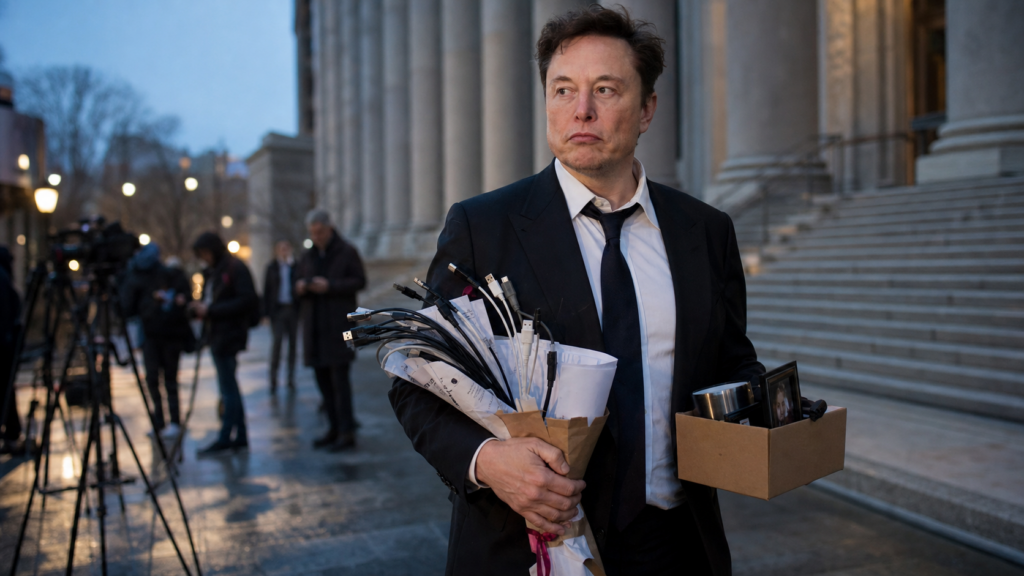
Courtroom witnesses said Musk reacted by preparing an appeal, insisting the loss was really about procedure, and slowing down near the cameras as if the courthouse steps were a product launch. Aides later carried out a small cardboard box containing printed emails, a framed Slack notification, and a cable bouquet nobody had asked him to bring.
“The law gives people deadlines,” Rusk added. “It does not give them a special drawer where they can keep old co-founder feelings until the other guy has a better office.”
Friends of Musk reportedly tried to comfort him by reminding him that he still owns multiple companies, rockets, a car brand, a social network, an AI company, and enough money to turn any normal disappointment into a multi-year public problem. The billionaire was said to perk up briefly before remembering none of those things can make Sam Altman look scared at dinner.
By nightfall, Musk had returned to X, where supporters assured him he had not lost because of any problem with his timing, argument, strategy, competing business interest, public conduct, witness testimony, or whole deal. He had lost because the system was afraid of a man brave enough to ask for the one thing money still cannot buy: a court order saying the old gang was mean to you.
At press time, Musk had vowed to take the fight to the Ninth Circuit, giving another group of judges the chance to tell him the same thing with better parking.