Hard Times: Chick-fil-A Now Limiting Customers To 1 Paper Towel Square And 4 Toilet Paper Squares
Chick-fil-A is addressing its serious financial problems by limiting customers to one square of paper towel and four squares of two-ply toilet paper, and customers are not happy.
ATLANTA – In what executives described as a necessary step to address the company’s increasingly serious financial problems, Chick-fil-A announced Tuesday that customers will now be limited to one square of paper towel per visit and four squares of two-ply toilet paper per bathroom trip, effective immediately at participating locations and morally binding at all others.
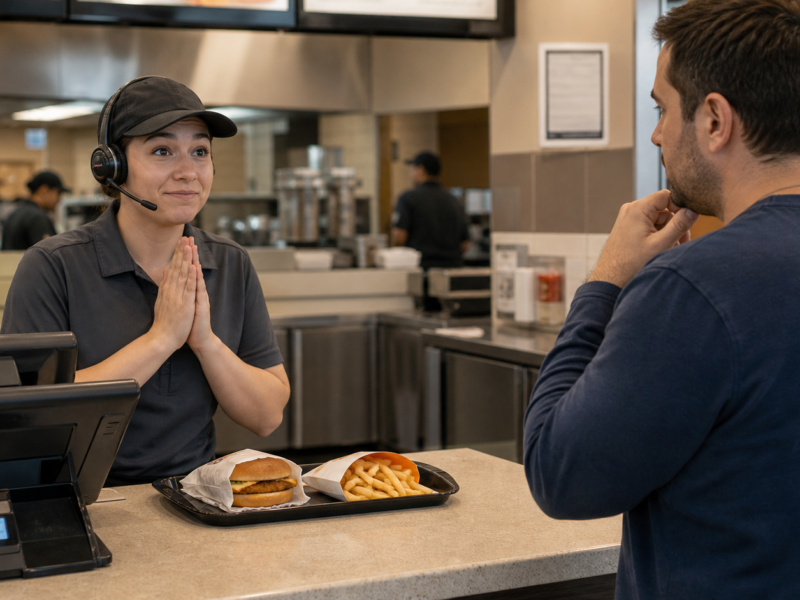
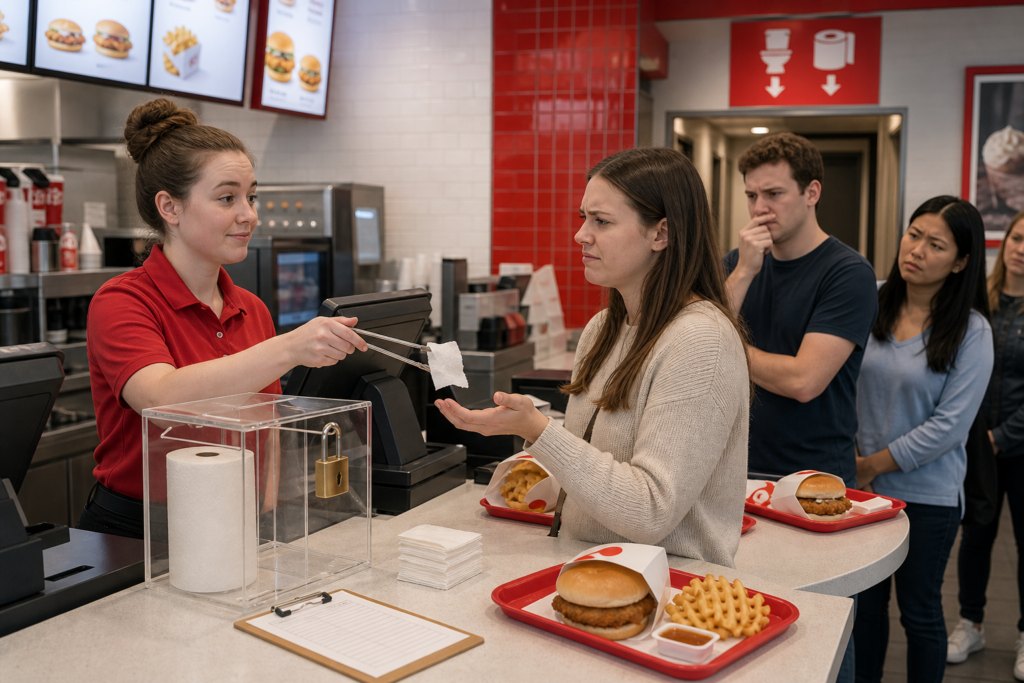
The new austerity program, called Stewardship In Every Square, will require guests to request paper products directly from a team member, who will tear off the approved amount with the same forced cheerfulness normally reserved for saying “my pleasure” to a man who just ordered eight sauces for one sandwich.
“We understand this is a difficult moment for our guests,” said Chick-fil-A vice president of resource discipline Brent Haviland. “But after reviewing the numbers, we realized the company could no longer sustain a model where customers were taking paper towels as though hand moisture were a human-rights issue.”
Haviland said the company reached the decision after an internal audit found that some customers were using as many as three paper towels after washing their hands, a behavior executives characterized as “financially violent” and “incompatible with chicken stewardship.”
“We are still committed to hospitality,” Haviland said. “We are simply asking guests to participate in that hospitality by leaving the restroom slightly damp.”
Under the new policy, customers who purchase a combo meal will receive one standard paper towel square, while guests who order only a sandwich will be offered half a square folded diagonally “to preserve dignity.” Customers who ask for extra sauce, extra napkins, or extra time to decide may have their paper privileges reviewed by a shift lead.
Bathroom access will also move to a tiered model. Standard customers will receive four squares of two-ply toilet paper, while Chick-fil-A One Silver members may unlock six squares after confirming through the app that their situation is “meaningful but not excessive.” Red members will receive access to the premium roll, located behind the counter in a clear acrylic case beside the lost-and-found AirPods.
“This is about fairness,” Haviland said. “If one guest takes twelve squares, another guest may have to experience the restroom with nothing but courage and a receipt.”
Customers were not happy.
“I paid $14 for nuggets, fries, and a lemonade that is mostly ice,” said 38-year-old customer Denise Wilcox, holding her single paper towel square in both hands like a tiny government-issued flag. “Now I’m supposed to dry both hands with something the size of a communion wafer? At a certain point, just say the Lord doesn’t want us dry anymore.”
Wilcox said she attempted to appeal the ration after accidentally touching the restroom faucet with her wrist, but was told by an employee that moisture exceptions are only available for catering orders of 20 or more.
“The kid looked sad,” Wilcox said. “He wanted to help me. But there was a manager behind him with a clipboard.”
At a location in suburban Raleigh, witnesses said tensions rose after a father of three attempted to take an additional napkin from the condiment station, triggering what employees internally call a Red Basket Event.
“Sir, that napkin is not included in your meal,” a team member reportedly told the man while another employee gently removed Polynesian sauce from the area as a precaution.
The father later told reporters he had only wanted to clean waffle-fry grease from his steering wheel before returning to a car containing “the stickiest children in Wake County.”
“I wasn’t trying to bankrupt the company,” he said. “I just didn’t want my minivan to become a honey-mustard swamp.”
Economists said the move reflects a broader pattern across the fast-food industry, where companies are searching for new ways to reduce costs without touching executive pay, franchise fees, app-development budgets, or the architectural decision to make every drive-thru look like an airport evacuation lane.
“Paper products are an obvious target,” said restaurant analyst Graham Keel. “They are visible, cheap, and used by everyone. More importantly, customers notice when you take them away, which creates the impression that the company is doing something serious, like a submarine sealing doors.”
Keel said Chick-fil-A’s policy could inspire similar cutbacks across the sector, including McDonald’s limiting ketchup to “one packet with feelings,” Chipotle charging 39 cents to look at a napkin stack, and Panera asking customers to bring a towel from home if they plan to order soup.
“The industry has learned that people will accept almost anything if you call it an app feature,” Keel said.
Chick-fil-A workers said the rollout has been challenging, particularly because employees are still expected to remain relentlessly polite while denying customers access to basic dryness.
“A woman asked me for another paper towel because her toddler spilled milk,” said one team member, who requested anonymity because he is not authorized to speak publicly about napkin scarcity. “I had to tell her, ‘My pleasure, but no.’ Those two phrases are not meant to be near each other.”
Another employee said the new toilet-paper limits have forced staff to make judgments no 19-year-old should be asked to make during a lunch rush.
“There are people coming out of the restroom with a look in their eyes,” the employee said. “You know four wasn’t enough. They know four wasn’t enough. But the policy says four.”
To ease the transition, Chick-fil-A said restaurants will install educational signage explaining approved drying techniques, including The Palm Press, The Wrist Flick, and The Humble Swipe, a method in which guests use the paper towel once and then stare at it for several seconds before accepting that this is their life now.
The company also announced a new sustainability-themed marketing campaign encouraging customers to view the rationing as an act of environmental care rather than a chicken restaurant screaming into a spreadsheet.
“Every square matters,” Haviland said. “Every hand can dry itself most of the way. Every guest can make a small sacrifice so Chick-fil-A can continue serving them with warmth, excellence, and one napkin counted by a teenager in a headset.”
At press time, the company was reportedly testing an even stricter pilot program in which customers who say “Can I get a few napkins?” are gently reminded that “a few” is not a unit recognized by finance.