Brave: Cate Blanchett Will Save #MeToo By Counting Women On Set Until The Men Feel Weird Enough To Leave
Hollywood finally has a plan to revive #MeToo: Cate Blanchett counting women on set until the men feel weird enough to leave.
Hollywood finally has a plan to revive #MeToo, and it is exactly as expensive, vague, and useless as everyone hoped: Cate Blanchett will personally count the women on every film set each morning until the men feel weird enough to leave.
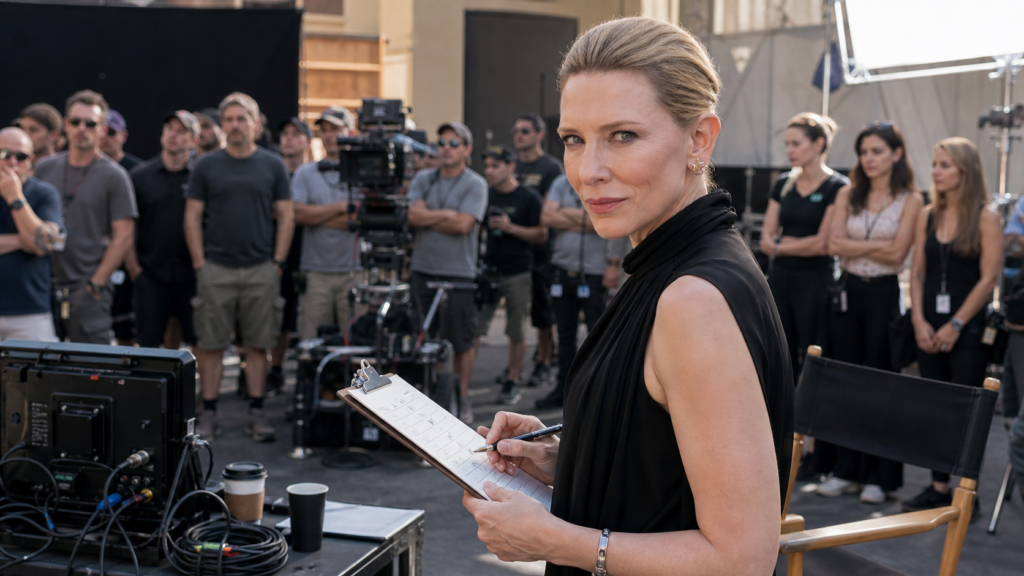
The emergency initiative follows Blanchett’s comments at Cannes that #MeToo “got killed very quickly” in Hollywood, where she said she still does a daily headcount on sets and regularly finds “10 women and 75 men” standing around waiting for someone to pretend that ratio happened by accident.
Honestly, if feminism can be reduced to Cate Blanchett silently doing girl math with a clipboard near the grip truck, maybe Hollywood was always going to handle this beautifully.
According to studio insiders, the new program, called Count Her If You Can, will require Blanchett to arrive before call time, stand beside craft services, and mark every woman she sees with a tasteful black tick while making hard eye contact with every man who tries to explain that camera crews are “just historically like this.”
“This is a bold next step in accountability,” said Silas Meade, executive vice president of responsible optics at a major studio that asked not to be named because it is currently shooting a female empowerment thriller with 112 men and a woman holding the continuity binder. “For too long, Hollywood has treated gender disparity as an invisible problem. Cate has made it visible by literally counting the ladies, which is basically policy now.”
Meade said the studio expects the initiative to make an immediate difference, especially after Blanchett reaches 11 women and everyone gets to clap because the day is technically better than yesterday.
Sources say the headcount will be followed by a brief “reflection window” in which male crew members are invited to look down at their boots, remember a joke they made near a PA in 2009, and decide whether they are part of the problem or merely standing in the same lunch line as it.
Early trials have already produced promising results. On one prestige drama, Blanchett reportedly counted nine women, 68 men, one nonbinary intimacy coordinator, and a French producer who kept moving behind the monitor so he would be counted as “European context.”
“Cate paused at 68 and just stared at us,” said first assistant director Glenn Pritchard, 49, who described the moment as “powerful, awkward, and unlikely to affect hiring.” “Then someone yelled ‘rolling’ and we all went back to making the movie exactly the same way.”
The system includes several escalation tiers. If a set has fewer than 10 women, a producer must say “we hear you” into a walkie-talkie. If there are more than 75 men, the lead actor must remove his sunglasses indoors. If the ratio gets worse after lunch, a development executive in Los Angeles receives an automated Slack message reading, “Not ideal,” which industry observers are calling the most aggressive reform mechanism since the all-female group photo.
At 100 men, the studio is required to add one woman to the poster.
Blanchett has reportedly embraced the role with the grim dignity of a woman who has won two Oscars and still has to count the boom operators because nobody else in the building can be trusted with subtraction.
“I love men,” she told colleagues during one morning count, according to a person present. “I just love them slightly less when there are 75 of them and they have all independently decided the same wraparound sunglasses are a personality.”
Some industry veterans have privately questioned whether counting women every morning is enough to address decades of power imbalance, harassment, gatekeeping, soft retaliation, creepy mentorship, festival self-congratulation, pay gaps, whisper networks, directors with scarves, producers named Chad, and the dead-eyed HR ladies who appear only when a lawsuit has already learned to walk.
Hollywood, however, insists the math is the work.
“Change does not happen overnight,” said Meade, pointing to a laminated chart showing that women now make up 13% of a particular lighting department if you include an intern who left at noon. “Sometimes change happens through difficult conversations. Sometimes it happens through structural reform. And sometimes it happens because Cate Blanchett counted the women, and a man named Brent felt embarrassed for almost seven seconds.”
Fans have praised Blanchett for speaking candidly about an industry that has spent nearly a decade turning #MeToo into panels, pins, lanyards, bravery lunches, female-forward streaming slates, and one extremely expensive black dress nobody was allowed to criticize.
Detractors, meanwhile, accused the actor of grandstanding, though several admitted the image of Cate Blanchett stalking a set with a clipboard like a pissed-off census angel did have legs.
By midday, studios were already exploring ways to scale the program without actually hiring more women. Proposed solutions include cardboard standees of female directors, a “woman ambience” audio bed for empty corners of the set, and a new premium inclusion package in which three men agree to grow their hair out and stand farther away.
One thing is for certain: #MeToo may have been killed very quickly, but thanks to Cate Blanchett, it can at least be counted every morning before the 75 men go back to making jokes that everybody has already heard.